Understanding how young athletes develop over time
How fast an athlete is today tells us something.
It does not tell us where they will finish.
The FAST ACT Development Study is an ongoing analysis of historical ACT school athletics results designed to help us better understand how running performance changes as young athletes grow and develop.
Using more than a decade of competition results, we are following performances across consecutive ages and examining the development patterns that emerge. We are interested not simply in who was fastest at a particular age, but what happened next.
How much did athletes typically improve from one year to another? Did athletes who were among the fastest when young remain there? At what ages did larger changes in performance occur? Were the development patterns the same for boys and girls? And what can individual athlete journeys teach us about interpreting junior performances?
The answers matter because the way we interpret performance can influence the opportunities we give young athletes.
Early performance matters — but it isn’t destiny
One of the most important findings emerging from our analysis is that two ideas can be true at the same time.
Being fast when young matters.
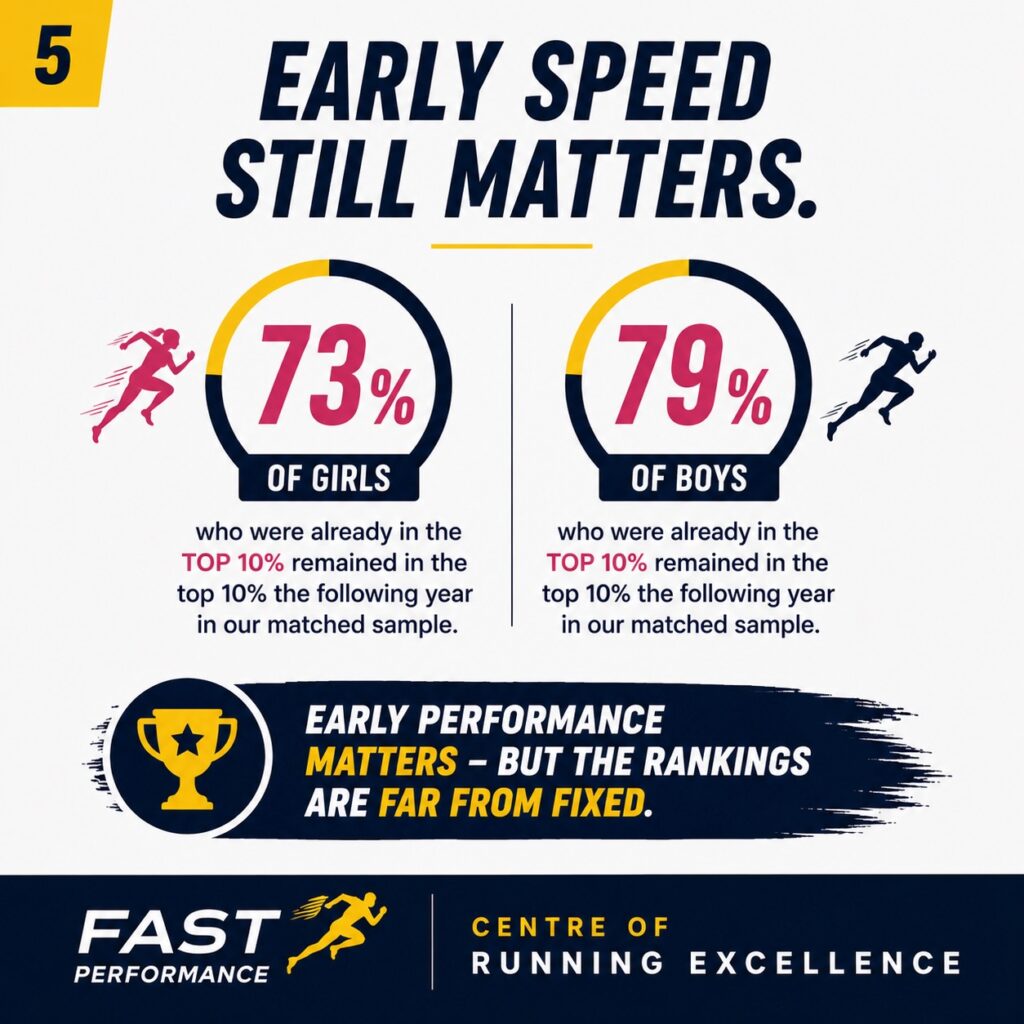
Among athletes in our matched sample who were already within the top 10% of performers, 73% of girls and 79% of boys remained within the top 10% the following year.
That is a substantial level of short-term persistence. It would therefore be wrong to suggest that junior performance tells us nothing about subsequent performance.
But it would be equally wrong to treat those rankings as fixed.
Athletes move through adolescence at different rates. Growth, maturation, training history, sporting background, health, motivation and opportunity can all influence the trajectory that follows.
Our data contains athletes who were exceptional when young and remained exceptional.
It also contains athletes who were much less prominent at younger ages and subsequently developed into some of the fastest athletes in their age group.
Early performance contains information. It just doesn’t contain destiny.
Development is not a straight line
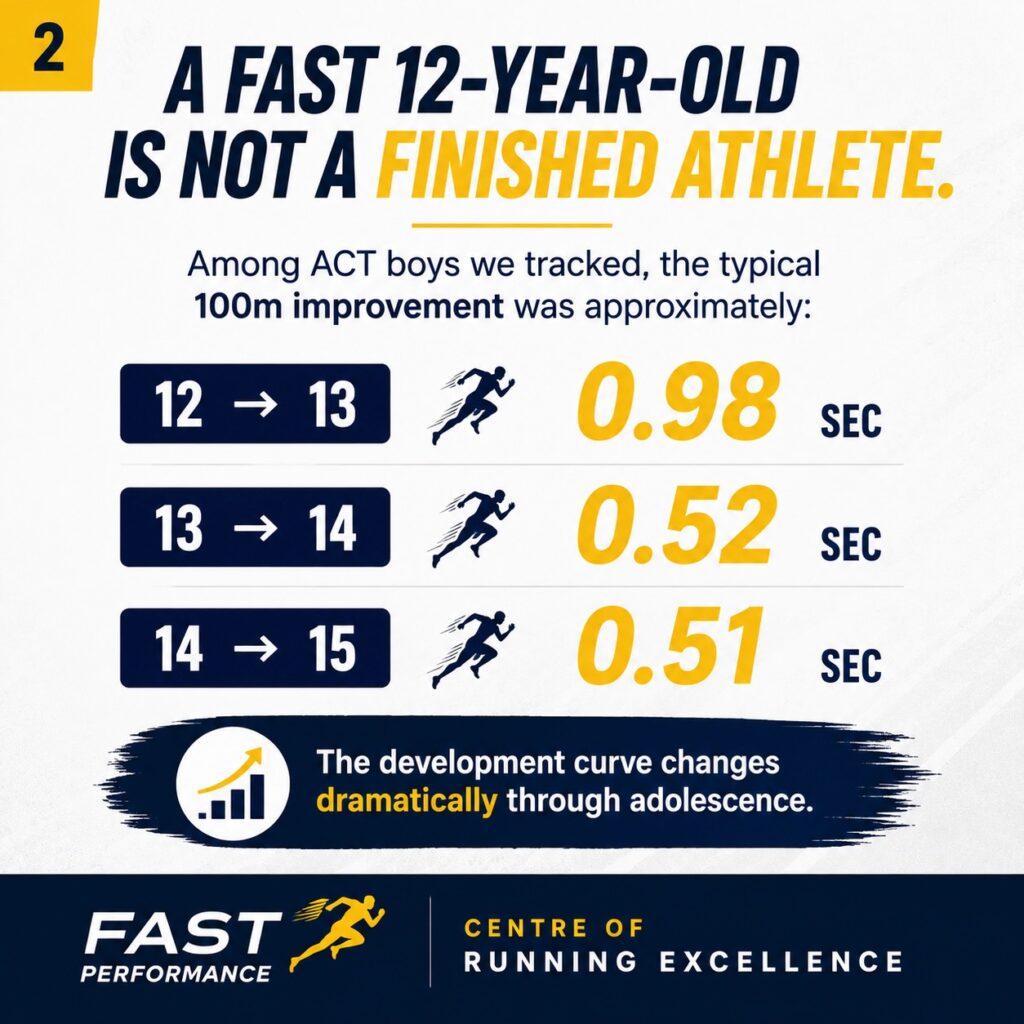
Perhaps the clearest lesson from longitudinal results is that improvement doesn’t occur at a constant rate.
Among the ACT boys we have tracked, the typical change in 100m performance varied considerably through adolescence. In our matched samples, the improvement from age 12 to 13 was approximately 0.98 seconds, compared with approximately 0.52 seconds from 13 to 14 and 0.51 seconds from 14 to 15.
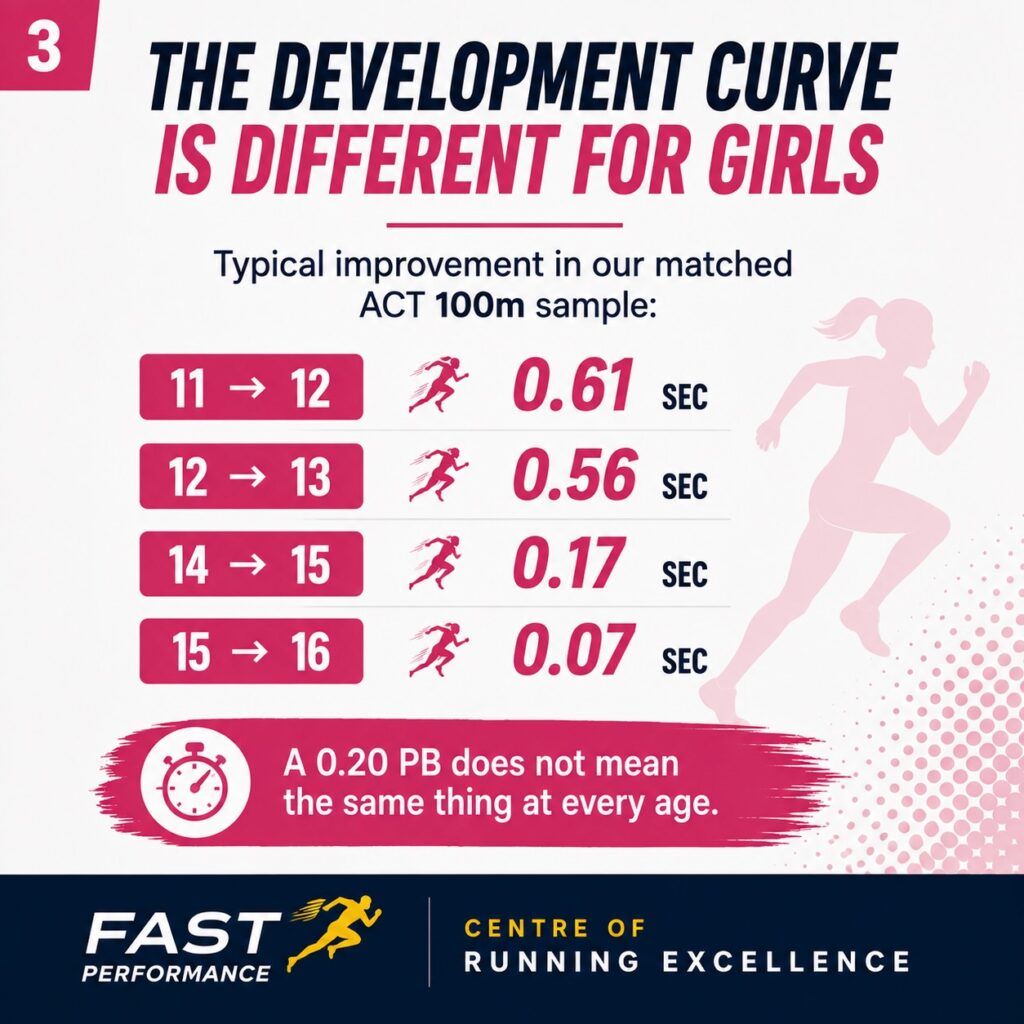
The pattern among girls was different.
In our matched female samples, typical 100m improvement was approximately 0.61 seconds from 11 to 12 and 0.56 seconds from 12 to 13. By the later teenage years, the observed changes were considerably smaller, including approximately 0.17 seconds from 14 to 15 and 0.07 seconds from 15 to 16.
These figures describe the athletes represented in our dataset. They are not prescriptions for how much an individual child should improve.
But they illustrate an important point.
A 0.20-second personal best does not mean the same thing at every age.
A young athlete can make substantial improvements during a period of rapid development without that necessarily indicating exceptional long-term potential. Conversely, a much smaller improvement by an older athlete may represent a significant performance breakthrough.
Context matters.
From 14.44 to 10.91
Individual journeys make that particularly clear.
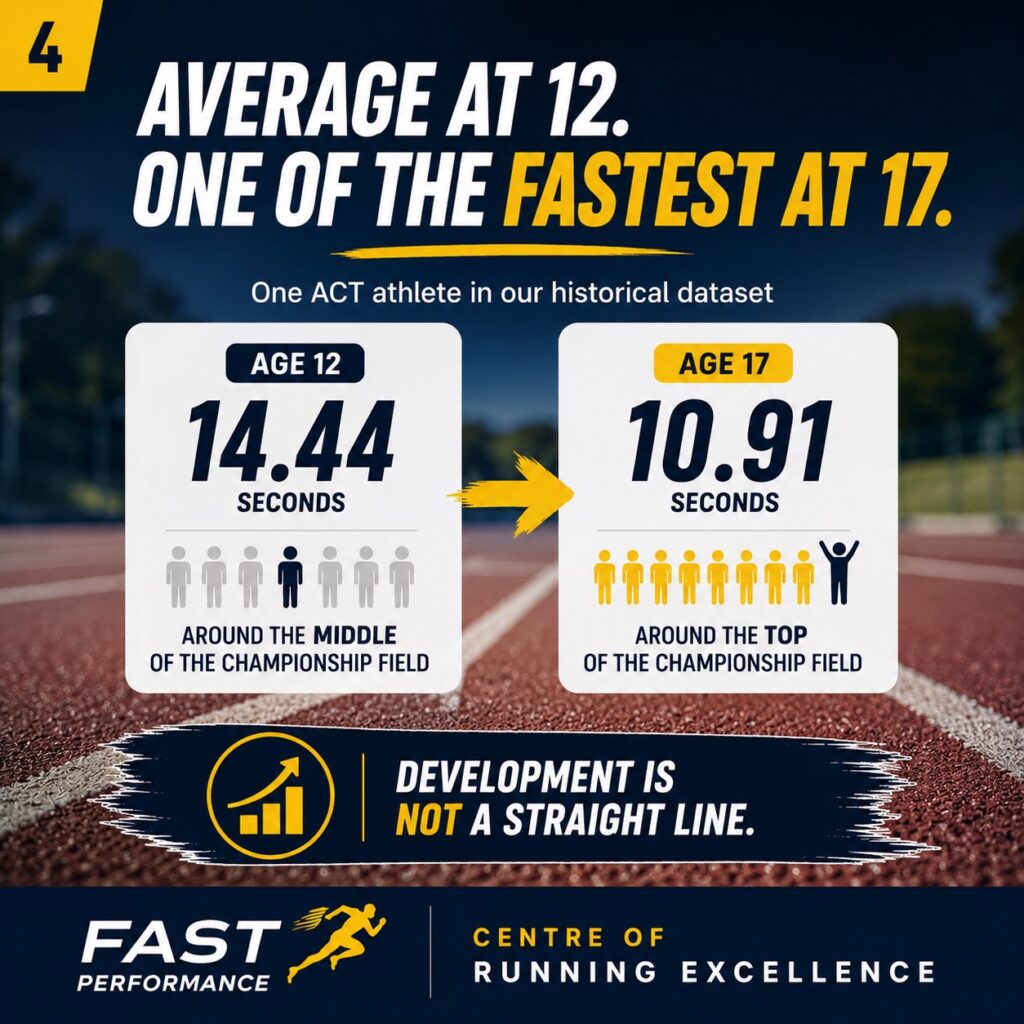
One athlete in our historical ACT dataset ran 14.44 for 100m at age 12, placing him around the middle of the championship field.
Five years later, at 17, he ran 10.91 and was around the top of the championship field.
Looking only at his performance at 12 would have provided very little indication of where his development would eventually take him.
This is not evidence that every middle-ranked 12-year-old will become an elite teenage sprinter. Most won’t.
Nor does it diminish the achievements of athletes who are already exceptional at 12.
Instead, it demonstrates the danger of treating a young athlete’s current position as their likely destination.
Performance is not potential
Two athletes can run exactly the same time today and still be on very different developmental trajectories.
One may have matured relatively early and already possess many of the physical advantages associated with adolescence. Another may be developing later and have considerably more physical change ahead.
One may have trained specifically for athletics for several years. Another may only recently have encountered structured sprint coaching.
One may improve rapidly over the next three years. Another may improve much more gradually.
Their performance today is real and should be recognised.
What we cannot do is assume that identical performances mean identical potential.
That distinction is particularly important when adults make decisions about young athletes based on rankings, medals or championship results.
Why FAST is studying this
At FAST, measurement is an important part of what we do.
We electronically time acceleration, flying sprints and longer runs. We record competition performances. We analyse technical development. Increasingly, we can compare contemporary information with historical results stretching back more than a decade.
But collecting data isn’t the objective.
Making better decisions for athletes is.
Understanding development helps us interpret what we’re seeing.
It reminds us to celebrate the athlete who is winning today without assuming they will always be ahead.
It reminds us not to overlook the athlete currently finishing in the middle of the field.
It helps coaches recognise when improvement may partly reflect normal development and when a performance change may be particularly significant.
Most importantly, it reinforces the need to coach the athlete in front of us, rather than the athlete we predict they might become.
What the study does — and doesn’t — tell us
The FAST ACT Development Study is an observational analysis of historical competition results.
Where possible, athletes are matched longitudinally so we can examine the same athletes across consecutive ages rather than simply comparing one year’s group of children with another.
There are important limitations.
Competition results alone cannot tell us how much an athlete was training, what other sports they played, their biological maturity, injury history, coaching environment, motivation or many of the other factors that influence development.
The study therefore cannot establish that training caused a particular improvement, nor can it provide a formula for predicting how fast an individual child will eventually become.
We don’t intend to use it that way.
Instead, the purpose is to identify patterns within our local athletics population, ask better questions and add another source of evidence to the decisions we make as coaches.
As the database grows, we will continue refining the analysis and exploring additional events, ages and development pathways.
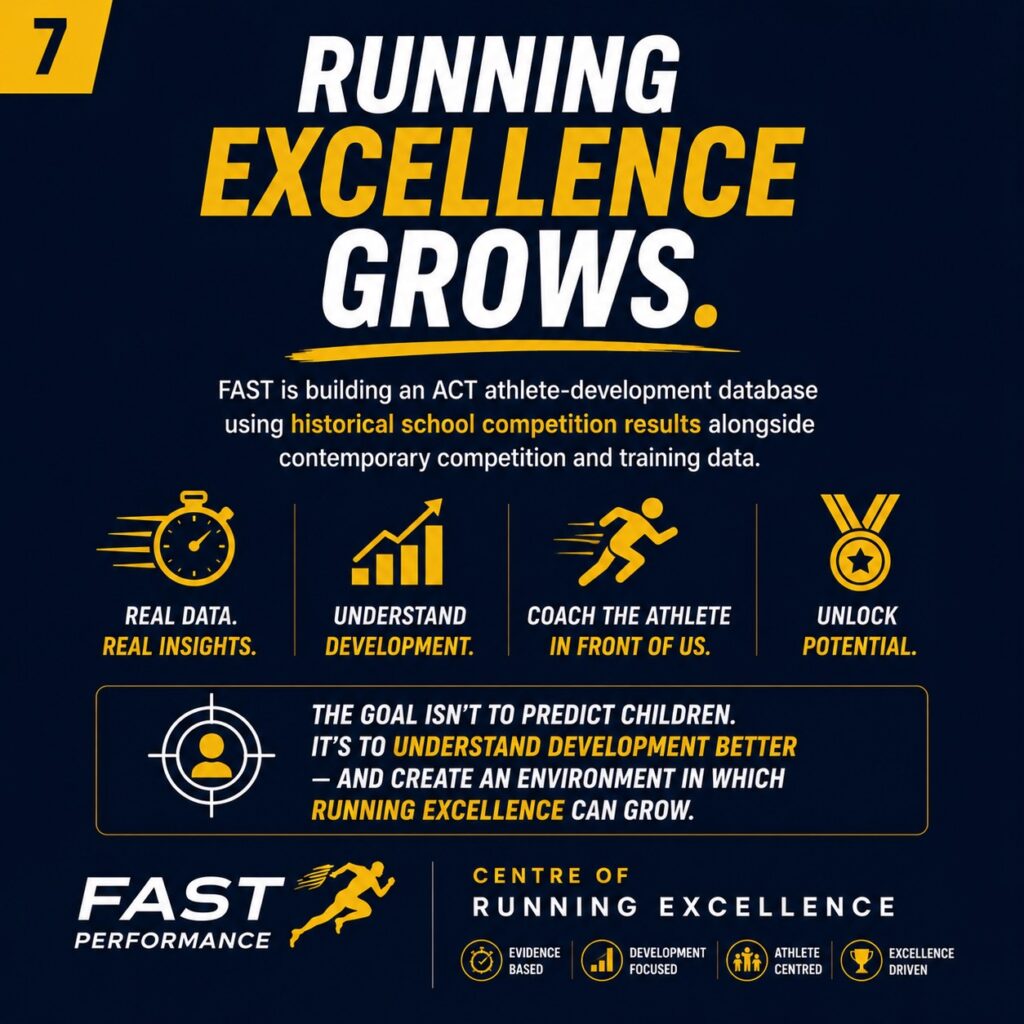
Creating an environment in which excellence can grow
There is a natural temptation in junior sport to identify talent early.
The fastest child attracts attention. Rankings become important. Championship results can begin to feel like evidence of what an athlete might eventually become.
Our data gives us good reason to be more thoughtful.
Recognise excellence when it occurs.
Celebrate winning.
Celebrate personal bests.
Give talented young athletes opportunities to develop.
But don’t mistake today’s result for tomorrow’s ceiling.
For parents, that may mean worrying a little less about exactly where a child sits in the rankings and concentrating more on whether they are enjoying sport, learning, developing good movement skills and wanting to return.
For coaches, it means remaining curious about every athlete.
And for athletes, perhaps the message is simplest of all:
How fast you are today is not where you finish.
The FAST ACT Development Study will continue to grow alongside the athletes it seeks to understand.
Real data. Better understanding. Better coaching.
Running Excellence grows. 🖤❤️