
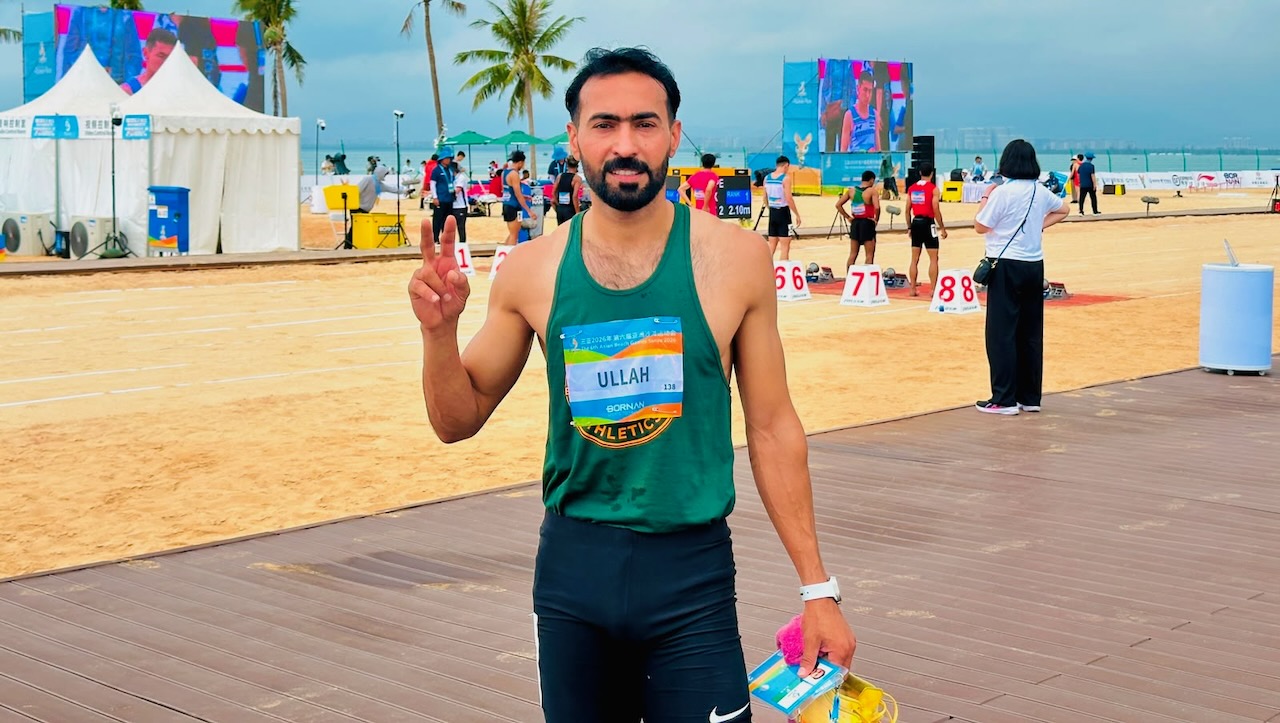
National silver, two personal bests and another milestone in FAST Running’s international development program.
Pakistan | November 2026
FAST Running’s international sprint program continues to produce outstanding results, with Sami Ullah Khan claiming silver in the men’s 100m at the South Asian Games trials in Pakistan, recording a new personal best of 10.65 seconds (NWI).
The performance moves Sami into third position on FAST Running’s all-time men’s 100m rankings, immediately behind Daniel Nwaobi and Vivian Williams. It’s a remarkable achievement for an athlete who only began training with FAST in June 2026 and has since recorded personal bests across every sprint distance he’s contested.
Sami wasn’t the only FAST athlete making his mark in the final. Seventeen-year-old Wajid Ali also delivered a personal best of 10.93 seconds, continuing his own impressive development since joining our international coaching program.
With four male athletes now recording 100m performances under 11 seconds, FAST’s growing sprint depth is becoming one of the most encouraging aspects of our international development work. The results are another demonstration that Running Excellence isn’t confined to a particular track, city or country.
From June to National Silver
When Sami began working with FAST Running in June, the objective was to develop his sprinting through a structured program that addressed the technical and physical qualities required for faster performances.
Over the months that followed, his commitment to training has been exceptional. He’s approached the program with consistency, maintained excellent communication and demonstrated a willingness to learn and apply the principles behind each session.
That commitment has been reflected in his performances. Since joining FAST, Sami has recorded personal bests across his sprint distances, with his latest 10.65-second 100m representing another significant step forward.
Finishing second at the South Asian Games trials is an important achievement, but the manner of his progression is equally encouraging. Sami is developing the ability to produce fast performances in competition while continuing to improve the technical qualities that support his sprinting.
His 10.65 also places him among the fastest athletes in FAST Running’s history, moving directly behind Vivian Williams and Daniel Nwaobi on our overall men’s 100m rankings.
Those names provide an exciting benchmark for the next stage of his development. Daniel recently recorded 10.60 seconds at the ACT Athletics Summer Series, while Vivian remains at the top of our historical rankings. Sami is now close enough to both athletes for the competition within FAST’s all-time list to become particularly interesting.
The performances have been achieved under different competition conditions, including races where legal wind information was unavailable or where wind assistance was recorded. Nevertheless, the rankings provide a valuable historical reference for the speed our athletes are developing across the program.
More Than an Athlete: Sami’s Leadership in Pakistan
While Sami’s performances on the track deserve recognition, his contribution to FAST Running extends beyond his own results.
One of the qualities we value most is his commitment to supporting the younger athletes around him. Sami has taken an active role in mentoring our junior sprinters in Pakistan, helping them understand the expectations of training, encouraging consistency and demonstrating the standards required to improve.
His training ethic provides an excellent example for athletes who are still learning what purposeful preparation involves. He approaches his own development seriously, but also recognises the importance of sharing his experience and supporting those following a similar pathway.
That combination of performance and leadership is particularly valuable within an international coaching environment. While FAST provides the programming, technical direction and ongoing support from Australia, the daily training culture in Pakistan is also shaped by the athletes themselves.
Sami’s willingness to lead by example strengthens that environment. His influence helps reinforce the importance of communication, commitment, resilience and personal responsibility, qualities that contribute to development long before they appear on a results sheet.
For FAST, that’s an achievement every bit as important as a national silver medal.
Wajid Ali Continues His Remarkable Progress
Alongside Sami in the 100m final was another FAST athlete whose development has been particularly exciting to follow.
At just 17 years of age, Wajid Ali recorded 10.93 seconds, another personal best and an important milestone in his progression through the sprint ranks.
Since joining FAST Running, Wajid has continued to improve across multiple distances, demonstrating the benefits of a structured approach to acceleration, maximum velocity development and sprint-specific preparation.
His performances have reflected both his natural speed and his willingness to commit to the work required to develop it. Training alongside more experienced athletes such as Sami provides an opportunity to learn from their preparation, observe their approach to competition and understand the standards needed to progress towards senior-level performance.
Wajid’s 10.93 is another encouraging result, particularly given his age and the development opportunities still ahead of him.
For FAST, having both Sami and Wajid competing in the same final demonstrates the value of building a training environment where established athletes and emerging juniors can develop together.
Four Sub-11-Second Sprinters, One Coaching Philosophy
With Vivian Williams, Daniel Nwaobi, Sami Ullah Khan and Wajid Ali all having recorded 100m performances under 11 seconds, FAST Running now has four male athletes who have reached an important sprinting milestone.
What makes this achievement particularly significant is that these athletes aren’t all training in the same location.
Our Australian athletes work within the FAST training environment in Canberra, while Sami and Wajid follow adapted programs in Pakistan. Their facilities, training circumstances and competitive calendars may differ, but the underlying coaching principles remain consistent.
At FAST, we don’t believe effective coaching means delivering identical sessions to every athlete. It means understanding the individual, identifying the qualities they need to develop and applying a proven training framework in a way that reflects their circumstances.
Acceleration, maximum velocity, running efficiency, strength, power and appropriate recovery remain central to the process. The training must then be adapted to the athlete’s age, experience, physical condition, event demands and available resources.
Communication is especially important when coaching across continents. Athletes must provide meaningful feedback about their sessions, physical condition and competition performances so the program can evolve as their needs change.
The recent performances of Sami, Wajid and Mohammad Zaid, who has also made substantial progress in the 400m and claimed national bronze in the 400m hurdles, demonstrate the encouraging results emerging from this approach.
The common factor isn’t geography. It’s the commitment to purposeful training, consistent communication and individual development.
Confidence, Momentum and the Road to February 2027
Sami is now enjoying a well-earned wave of confidence following his national silver medal and latest personal best.
Confidence is an important part of sprint performance, particularly when it develops from consistent preparation and repeated evidence of improvement. Sami has experienced that progression since June, and his latest result provides another reason to believe there’s more to come.
With another training block ahead, attention will increasingly turn towards selection for the South Asian Games in February 2027.
The next phase will focus on consolidating the qualities Sami has developed, continuing to improve his acceleration and maximum velocity, and preparing him to deliver his best performances when selection opportunities arise.
His position in the FAST all-time rankings adds another interesting dimension. With Daniel and Vivian immediately ahead of him, Sami has a clear set of historical benchmarks to pursue. Closing the gap to those athletes, or potentially moving ahead of them, would represent another significant achievement in his development.
But the priority remains preparing Sami to become the best sprinter he can be. The rankings provide motivation, while the training process provides the means to improve.
Wajid also has important opportunities ahead. His progression to 10.93 seconds at 17 years of age gives him an encouraging foundation, and his continued development will be guided by the same commitment to long-term preparation rather than chasing immediate results at the expense of consistency.
Running Excellence Grows
The success of FAST Running’s international athletes is about more than medals, personal bests or positions on our historical rankings.
It’s about demonstrating that a consistent coaching philosophy can support athletes across different environments when the program is adapted intelligently and the athlete is committed to the process.
Since June, Sami has transformed his performances, established himself among FAST’s fastest-ever 100m sprinters and become an important mentor to the next generation of athletes in Pakistan. Wajid continues to improve alongside him, while the wider international squad is beginning to demonstrate the depth of development taking place.
Their achievements reflect the same principles we apply to our athletes in Canberra: consistency, commitment, resilience, communication and a willingness to keep learning.
Sami’s silver medal and 10.65-second performance are important milestones, but with another training block ahead and South Asian Games selection approaching, there is every reason to remain excited about the next chapter.
The stopwatch doesn’t care where an athlete trains. What matters is the quality of the preparation, the commitment to improvement and the ability to deliver when competition arrives.
From Canberra to Pakistan, FAST Running continues to grow, bringing athletes together through a shared commitment to getting better.
Running Excellence has no boundaries. 🇦🇺🇵🇰
FAST Running Australia
Comments are closed