
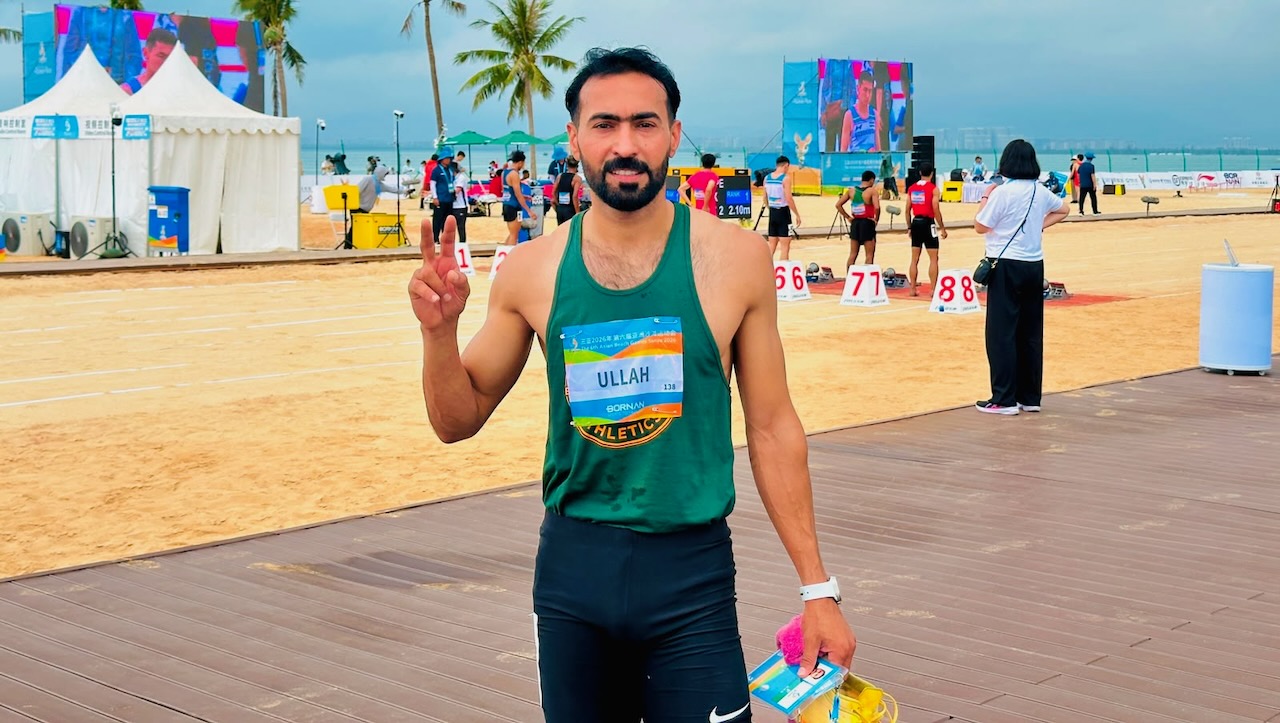
There is something refreshingly uncomplicated about Sami’s ambition.
He wants to run the 100 metres. He wants to become faster. He wants to challenge Pakistan’s electronically timed national benchmark of 10.38, break 10 seconds and ultimately pursue success at the Asian Games.
Those are enormous ambitions, and FAST has no interest in pretending otherwise. Running 100 metres at that level demands exceptional physical qualities, technical execution, years of consistent work and the ability to reproduce speed when competition matters.
What makes Sami particularly interesting is that he already brings considerable raw material to that challenge.
Strength Is Already Part of the Story
Some of Sami’s most striking footage doesn’t initially come from the track.
He is a powerful athlete in the gym. Heavy assisted squat work demonstrates substantial force-producing capacity, while his ability to execute an unassisted Nordic hamstring exercise provides another glimpse of the physical qualities he has developed.
Then we see him run.
His training numbers have included standing 30m efforts around 3.55–3.61 hand timed, 50 metres in 5.43 and 5.51, and repeated Flying 20 performances reported between approximately 1.84 and 1.91. He has also produced a hand-timed 10.2 training 100m.
Those numbers are exciting, but FAST is deliberately cautious about what they mean.
Hand timing, video timing and fully automatic electronic timing are not interchangeable. A spectacular training stopwatch reading does not become an official personal best simply because the number looks good.
For an athlete with Sami’s ambitions, measurement needs to become more rigorous, not less.
That is why his controlled and competition performances matter. We have recorded a 10.70 Nationals win and a performance around 10.46, providing more useful benchmarks against which future progress can be assessed.
Turning Physical Capacity Into Sprint Performance
Sami’s challenge is therefore not simply to become stronger.
He is already strong.
Nor is it to spend every session proving how fast he can run 100 metres.
FAST Sprint programming is designed to develop the individual components from which the complete race emerges. Projection and acceleration establish the opening. Maximum velocity determines the athlete’s ultimate speed capability. Technical work develops the positions, rhythm and contacts required to express that speed efficiently, while carefully selected longer sprint work develops the ability to resist unnecessary deterioration later in the race.
The aim is to make all of those qualities work together.
That distinction becomes particularly important with a physically powerful athlete. Strength in the gym only matters to sprint performance when the athlete can apply force effectively at the speeds and within the extraordinarily short ground-contact times demanded by sprinting.
Sami’s program therefore isn’t about accumulating impressive exercises or impressive stopwatch readings. It is about improving transfer.
Ambition Requires Evidence
Sami has already experienced success in Pakistan and has described himself as a national champion. His sights, however, are set considerably higher.
He wants to challenge Pakistan’s best.
Beyond that sits the ambition of an Asian Games medal and, ultimately, breaking one of sprinting’s great barriers: 10 seconds for 100 metres.
FAST won’t promise him those outcomes.
What we can do is build a performance process capable of testing how far his ability can take him.
That means measuring honestly, identifying weaknesses rather than hiding them, developing the qualities required for elite sprinting and progressively exposing those qualities to competition. It means understanding that a 10.2 hand-timed training run is encouraging evidence, but the performances that ultimately define the journey will be produced under electronic timing, in competition, when the result counts.
The Journey Won’t Always Be Straight
There is another reality behind ambitious performance goals.
Progress rarely arrives in a straight line.
There will be sessions that go brilliantly and others that don’t. There will be competitions, interruptions, injuries and circumstances outside sport that no training program can predict.
For an athlete chasing something as significant as Sami is, those moments can feel enormous. When the next trial or championship matters deeply, it is easy for one interrupted week to feel as though the entire opportunity is disappearing.
It isn’t.
High performance is built over much longer periods than that.
Sometimes the most important decision is to push. Sometimes it is to recover. Sometimes circumstances outside athletics simply have to come first.
None of those things changes the ambition.
Sami’s goals remain where they were. Our responsibility as coaches is not to panic every time the path bends, but to keep making the best decision for the athlete standing in front of us.
The destination hasn’t changed simply because the journey became difficult.
FAST Sprint in Pakistan
Sami follows the FAST Sprint pathway, sharing the principles applied to our sprint athletes in Canberra while receiving individual refinements around his own performance and circumstances in Pakistan.
That distinction is important.
FAST Performance is not about making every athlete complete exactly the same program. It is about creating a common performance framework from which individual coaching decisions can be made.
For Sami, the destination he has identified is ambitious.
The next step is much simpler.
Keep building the athlete capable of getting there.
Strength is already part of his story. Speed clearly is too. Our job together is to keep developing the connection between them and establish, through increasingly reliable competition performances, just how fast Sami can become.
There will be setbacks along the way. There will also be opportunities that today we cannot see.
One week won’t define either of them.
Welcome to FAST Performance, Sami.

Comments are closed