
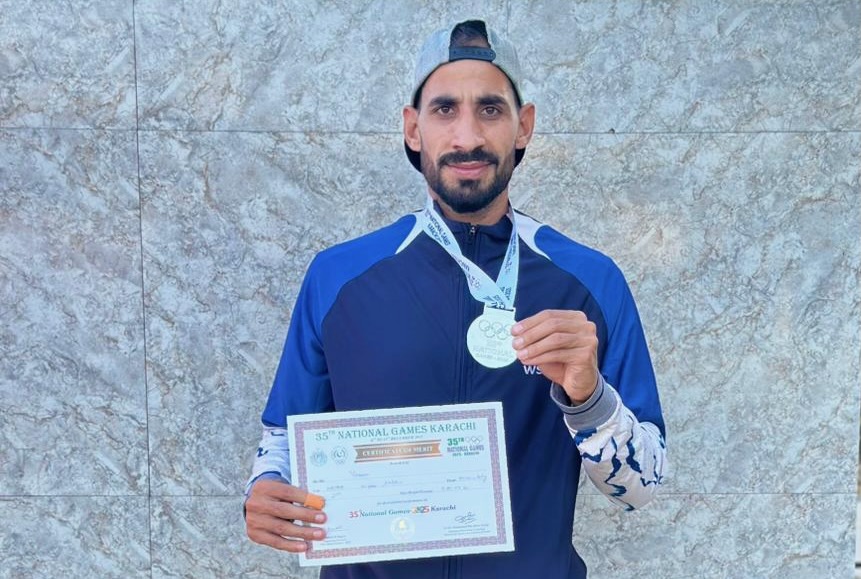
Muhammad Yasin came to FAST Performance with something every 400-metre coach wants to see: an athlete who could already run.
With a reported 400m personal best of 48.30, Yasin had demonstrated the speed endurance and competitive ability required to run at a high level in Pakistan. His training performances reinforced that picture. Repetitions such as 300 metres in 35.70 and 36.40 and 150 metres in 17.56 and 17.67 showed an athlete capable of carrying substantial speed over distance.
For FAST, however, those performances raised an important question. If Yasin could already endure speed effectively, would simply adding more of the same make him a substantially better 400m runner?
Our answer has increasingly been no.
Finding Speed Before Adding More Endurance
The 400 metres is demanding enough that it is tempting to build a program around fatigue. Longer repetitions, shorter recoveries and increasingly difficult sessions can certainly make an athlete tired, but fatigue itself is not the objective. Ultimately, the athlete needs enough absolute speed that the required race velocity represents a manageable proportion of what they can produce at maximum velocity.
That has become an important part of Yasin’s FAST program.
Rather than viewing him only as a 400m runner, we have been developing the qualities underneath his 400m performance. Acceleration, maximum velocity, posture, stiffness and effective force application have therefore sat alongside the speed-endurance qualities he already possesses.
His sessions increasingly reflect that approach. Wicket runs provide opportunities to develop rhythm and upright sprint mechanics. Sled work and hurdle pushes develop projection and acceleration. Maximum-velocity work exposes him to speeds that cannot be developed by repeatedly running 300s, while longer work allows those qualities to be integrated back into the demands of his primary event.
This is not an attempt to turn a 400m runner into a 100m specialist. It is about giving the 400m athlete a larger speed reserve.
What Fatigue Tells Us
Yasin’s training has also provided useful information about what happens when that speed begins to deteriorate.
As fatigue increases, we have seen occasions where his mechanics begin to change. Reaching and overstriding can introduce braking at exactly the point in a 400m where the athlete needs to preserve rhythm and continue directing force effectively into the track.
That gives us something much more useful than simply knowing whether a repetition was fast or slow.
It tells us what to coach.
The objective becomes maintaining posture and effective contacts as fatigue develops rather than asking Yasin merely to tolerate more fatigue. Technical development and conditioning therefore become connected rather than treated as separate parts of the program.
Maximum-velocity testing has also given us another way to monitor that process. Yasin has produced a best Flying 20 around 1.92 seconds in training and an 80m benchmark of 8.98, giving FAST reference points that can be revisited as his program develops. Not every session has been faster than the one before it, nor should it be. Illness, accumulated load, environmental conditions and the purpose of a particular training week all influence performance.
The value comes from building a picture over time.
Coaching the 400 From Canberra to Pakistan
Like our other Pakistan-based athletes, Yasin’s program requires FAST principles to be translated into the environment available to him rather than copied blindly from a Canberra session.
He follows the FAST Performance structure through the Long Sprint pathway, with individual refinements applied according to his development, feedback and performance. Video allows technical observations to be made from Canberra, while times and session information provide another layer of objective feedback.
Distance therefore does not remove the coaching conversation. It changes how that conversation takes place.
For an athlete who has already run 48.30, the ambition cannot simply be to complete more training. The challenge is to find the improvements that move an established athlete forward.
For Yasin, we believe part of that opportunity lies in becoming faster before asking him to carry that speed further.
His endurance has already taken him a long way.
Now we are interested in discovering what happens when we raise the speed underneath it.
Welcome to FAST Performance, Muhammad Yasin. Running Excellence grows.
Comments are closed