
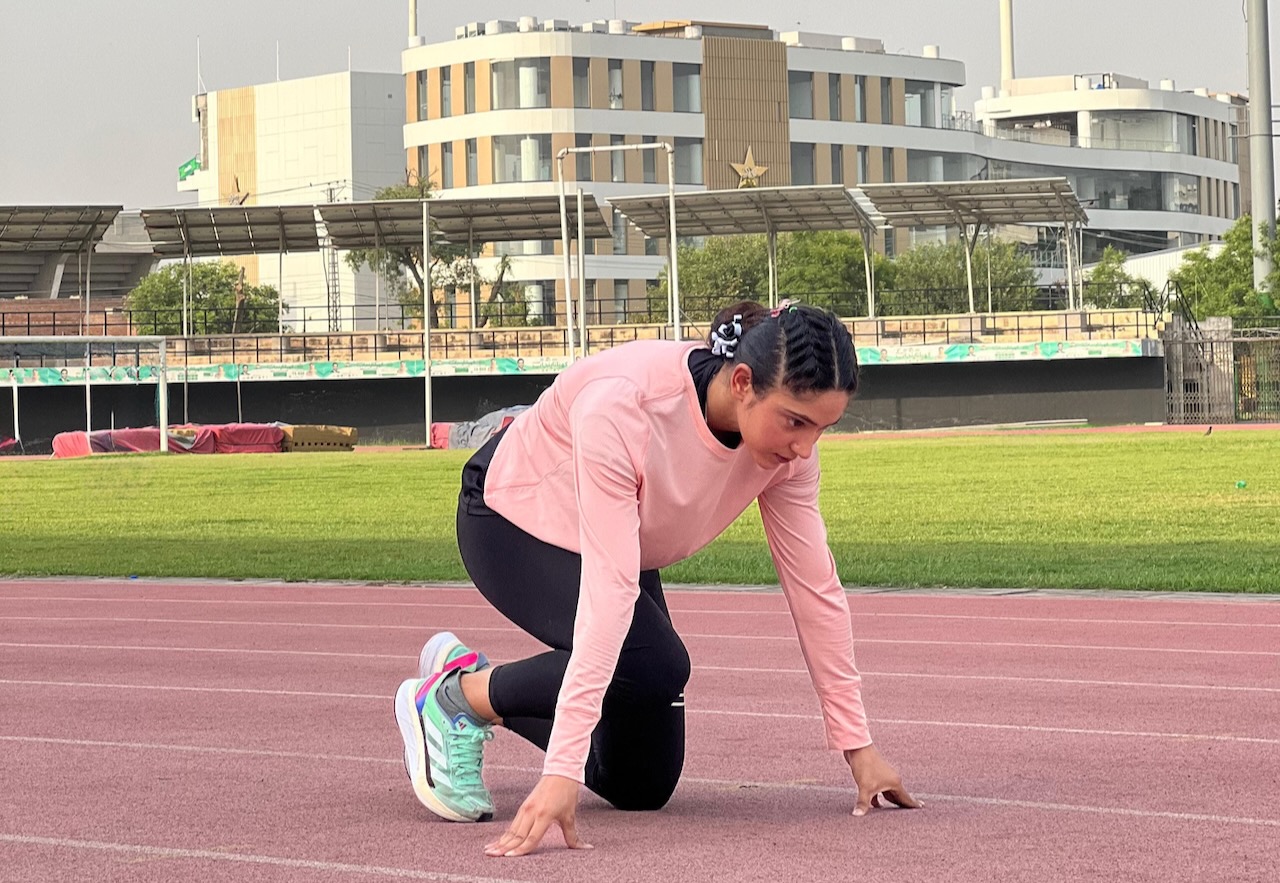
When Sunaina Musawar joined FAST Performance, she was not an athlete looking for her first breakthrough. She arrived with years of competition behind her, success across a remarkably broad range of events and, most importantly, evidence that she could perform when it mattered. For FAST, that makes the challenge particularly interesting. Coaching an established athlete is not about starting again. It is about understanding what has already made that athlete successful, identifying where further performance can be found and building a program capable of taking them somewhere they have not been before.
Sunaina’s athletics record in Pakistan provides a strong foundation. Representing Punjab University at the 2023 Pink Games, she was named Best Athlete after winning gold in the 100m, 400m, 800m and 4×100m relay. That breadth is significant. It demonstrates an athlete capable of expressing speed at one end of the spectrum while also possessing the strength and endurance required for longer races. Punjab University subsequently recognised her as Best Athlete at the All-Pakistan Women’s Inter-University Athletics Championship.
Her development has also included success at senior national level. In December 2023, Sunaina was part of the Higher Education Commission mixed 4×400m relay team that recorded 3:39.2 at the Pakistan Championships in Attock, a performance listed as the Pakistani national record. Her individual career then reached another important milestone at the 35th National Games in Karachi in December 2025, where she represented WAPDA and won the women’s 400m national title.
Those performances provide important context for the athlete who has now joined FAST. Sunaina already knows how to compete and win. The question facing athlete and coach is therefore not whether she is capable of performing at a high level, but what qualities need to develop if she is to move beyond the level she has already reached.
Building the Next Version of the Athlete
The 400 metres is sometimes characterised too simply as a test of how long an athlete can maintain a sprint. Our approach at FAST Performance is broader. Acceleration, maximum velocity, speed reserve, rhythm, efficiency and the ability to maintain effective mechanics under increasing fatigue all contribute to the final performance. Developing the event therefore requires more than simply asking an athlete to run harder or accumulate more demanding repetitions.
Sunaina’s background makes that particularly interesting. An athlete who has successfully competed from 100m through 800m already possesses a wide athletic base. The task is to determine how those qualities can best be organised around the demands of the 400m. That means developing speed rather than treating endurance as the automatic answer to every performance problem, while also ensuring that the athlete retains the specific strength and resilience required to carry that speed around the full lap.
FAST programming provides a structure for doing that. Sunaina works from the same performance principles that underpin our Canberra program, but her training is individualised for her event, current capabilities, training history and the environment available to her in Pakistan. Sessions can be adjusted as performances and feedback provide new information, rather than relying on a fixed program written weeks or months in advance.
Coaching Across Distance
There are obvious differences between coaching an athlete standing on the track in Canberra and coaching an athlete thousands of kilometres away in Pakistan. FAST cannot simply pretend those differences do not exist. Facilities, equipment, climate, training partners and access to suitable venues can all influence what is possible on a particular day.
Technology, however, allows distance to become a coaching consideration rather than an insurmountable barrier. Training footage allows us to examine movement and execution. Times and session results provide objective measures of performance. Regular communication provides the context behind those numbers: how an athlete felt, what conditions were like, whether the intended intensity was achieved and how the athlete responded afterwards.
That information feeds back into programming. The distances may change, recovery may change, technical priorities may shift and the emphasis within a training block can be adjusted. Good remote coaching cannot simply be the delivery of a spreadsheet from one country to another. It requires an ongoing relationship in which athlete and coach continue to exchange information and make decisions.
That process is already shaping Sunaina’s FAST journey.
FAST Performance Beyond Canberra
Sunaina’s arrival also represents something important in the continuing development of FAST Performance. Our performance environment began in Canberra, but the principles behind it do not depend upon an athlete being physically present at the AIS or at one of our regular training venues.
Our growing international group is demonstrating that athletes can train in very different environments while still being connected through a common performance system. Mohammad Zaid’s introduction to FAST first allowed us to explore that idea publicly in Running Excellence Has No Borders. Sunaina takes the story another step. This is no longer simply about whether FAST coaching can be delivered internationally. It is about established international athletes becoming part of FAST Performance and trusting us to contribute to the next stage of their development.
That distinction matters. We do not claim ownership of what these athletes achieved before arriving at FAST. Sunaina became a successful athlete through years of work in Pakistan, supported by the coaches, organisations and people who have been part of her journey. Her previous performances deserve to be recognised as exactly that: the foundation she brings with her.
Our responsibility begins with what happens next.
Sunaina has already been a university champion, earned Best Athlete recognition, contributed to a national relay record and become a National Games 400m champion. Those achievements tell us a great deal about where she has been, but high-performance coaching is ultimately concerned with what an athlete might still become.
That is the journey we are now beginning together.
Welcome to FAST Performance, Sunaina Musawar. Running Excellence grows.

Comments are closed