
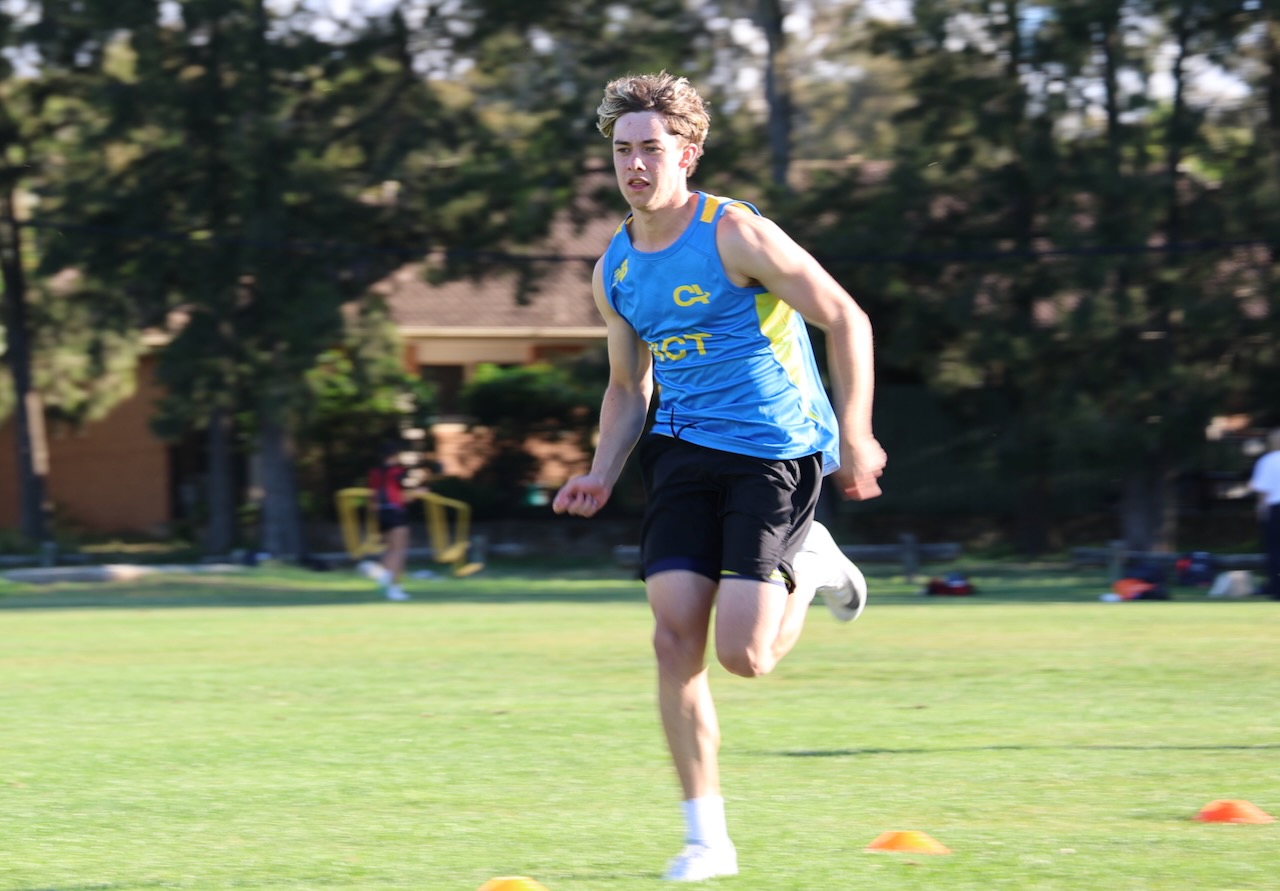
From 12-second sprinting to 10.88 in less than two years, Sam Blood is making his own way through the FAST Running record books.
Some athletes spend years working towards a particular performance barrier. Others progress steadily, taking small steps as their experience and confidence grow.
And then there’s Sam Blood.
Less than two years ago, Sam was running 12-second 100m races. At the Capital Athletics Summer Series on 7 November, he crossed the finish line in 10.88 seconds, becoming a sub-11-second sprinter for the first time under any conditions and moving into equal third position on FAST Running’s all-time men’s 100m rankings.
The performance was assisted by a +4.7 m/s tailwind, so it isn’t a wind-legal personal best. Nevertheless, the result represents another significant step in a remarkably rapid progression, particularly for an athlete who is still developing the technical, physical and competitive qualities needed for high-level sprinting.
Sam isn’t chasing anyone else’s journey. He’s building his own, and he doesn’t appear particularly interested in taking the scenic route.
From 12 Seconds to the FAST All-Time Top Three
The difference between a 12-second sprinter and an athlete capable of recording 10.88 is considerable. At this level, improvements become progressively harder to achieve, and finding even a few hundredths of a second can require substantial changes in technical execution, strength and physical preparation.
For Sam to make that journey in less than two years is an achievement worth recognising.
His development hasn’t simply involved running more repetitions or increasing training intensity. At FAST, our focus has been on improving the qualities that allow him to produce and maintain speed, including acceleration, maximum velocity mechanics, coordination and the strength required to support those movements.
The results have become increasingly apparent in competition. Sam’s 10.88 followed a 6.97-second performance in the 60m, where he finished just 0.02 seconds behind training partner Daniel Nwaobi.
That narrow margin reflects the quality of the sprinting environment Sam is now part of. Training alongside athletes capable of producing exceptional performances provides valuable opportunities to learn, compete and establish higher standards.
But Sam’s progress deserves to be recognised on its own terms. His improvement from 12-second racing to a place among FAST’s three fastest male 100m performers under all conditions is a story of individual development, commitment and growing capability.
Progress Hasn’t Come Without Challenges
Rapid improvement doesn’t mean the journey has been without difficulties.
Sam has had to manage physical challenges involving his foot, Achilles and calf, requiring careful adjustments to his sprint training and preparation. At times, that has meant modifying his use of spikes, managing training loads and maintaining strength and conditioning while protecting his ability to continue progressing.
For a young sprinter who wants to run fast, learning when to push and when to manage the workload is an important part of development.
Those challenges have reinforced the need for a sustainable approach. Sprinting places significant demands on the body, and the ability to tolerate repeated high-intensity efforts becomes increasingly important as an athlete develops.
At FAST, we want Sam to continue getting faster, but we also want him to remain healthy enough to train consistently and compete throughout the season. The two objectives are closely connected.
His progress demonstrates that ambitious performance goals and sensible physical preparation aren’t competing priorities. Both are necessary if an athlete is going to develop beyond a single breakthrough performance.
A Training Environment That Raises Expectations
One of the most enjoyable aspects of watching Sam develop has been seeing how he responds to the standards around him.
At the latest Summer Series, Daniel Nwaobi won the 60m in 6.95 seconds, with Sam immediately behind in 6.97. They returned for the 100m, where Daniel recorded 10.60 and Sam 10.88.
Those results reflect two athletes at different stages of their development, each contributing to an environment where fast running is becoming increasingly familiar.
Having a training partner who can challenge you is valuable, but Sam’s motivation isn’t defined by where Daniel finishes or where anyone else sits in the rankings.
His development is about discovering how much faster he can become.
That distinction matters. The strongest training environments encourage athletes to support one another while remaining responsible for their own progress. Sam benefits from the competition and camaraderie of the FAST sprint group, but the work he puts into his own development is what ultimately determines how far he can go.
Breaking 11 Seconds Is a Beginning
The 11-second barrier is an important milestone for any developing male sprinter. For Sam, recording 10.88 represents the first time he’s moved beyond it, even though the wind conditions mean a legal sub-11-second performance remains a target.
That’s now one of the next challenges.
The Australian All Schools Championships in December and the national championship season in April will provide further opportunities to test his progress against strong competition. Between now and then, the focus will remain on developing his speed, maintaining his physical resilience and preparing him to perform consistently when competition demands it.
There’s no need to rush that process simply because his performances have improved so quickly. In fact, the better Sam becomes, the more important it will be to manage his development carefully and build the foundations that allow further progress.
But there’s also no reason to underestimate what he’s already achieved.
Less than two years ago, Sam was a 12-second sprinter. Today, he has recorded 10.88, joined the FAST all-time top three and established himself as one of the exciting developing sprinters in our squad.
He’s not chasing anyone.
He’s in a hurry, and everyone knows it.
Running Excellence.
Comments are closed