
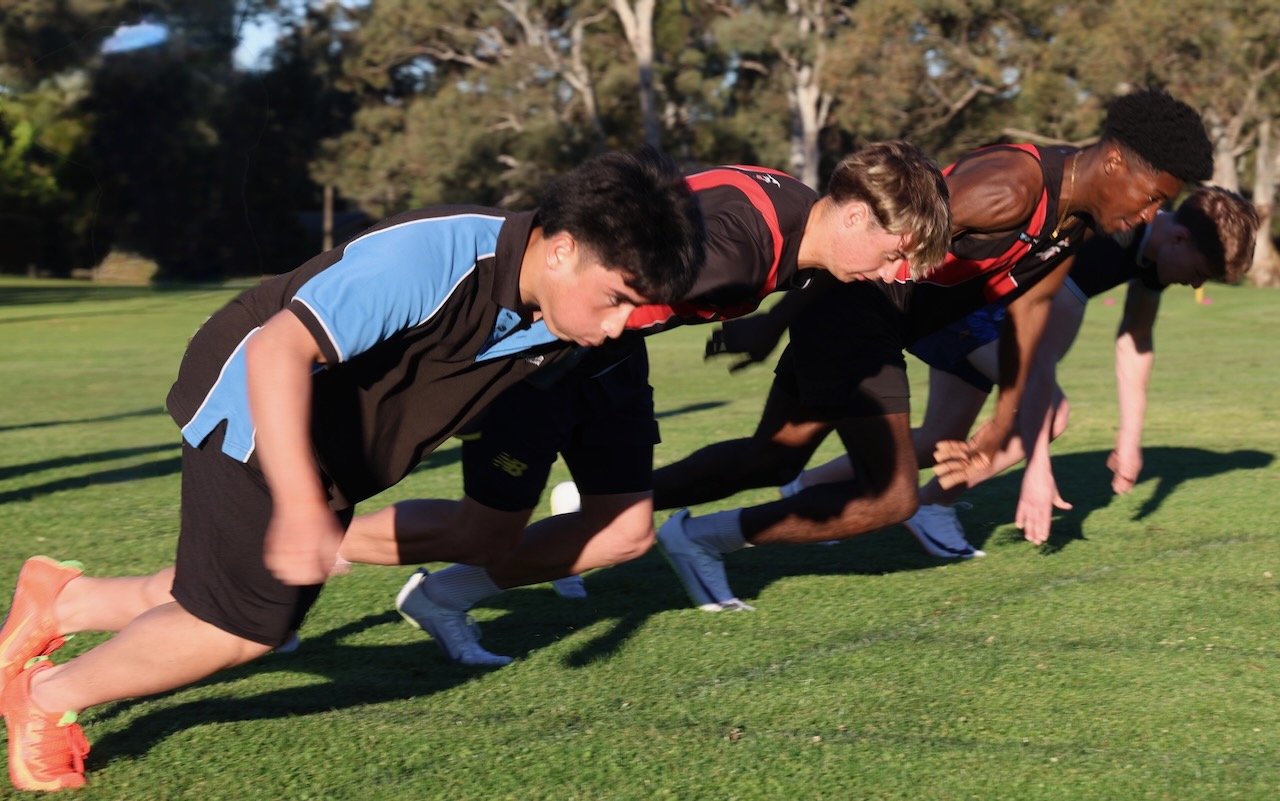
Separated by just two hundredths of a second, two FAST Performance athletes have produced 60m times that rank among Australia’s leading junior sprint performances of 2026.
There’s something particularly rewarding about watching two athletes from the same training group produce outstanding performances in the same race. They share training sessions, technical development, challenging workouts and the everyday experiences that contribute to becoming better sprinters. When they line up against one another in competition, however, each athlete has the opportunity to demonstrate how far their individual development has progressed.
At the Capital Athletics Summer Series in Canberra, FAST Running sprinters Daniel Nwaobi and Sam Blood delivered exactly that, recording 6.95 and 6.97 seconds respectively over 60 metres, separated by just 0.02 seconds at the finish.
Both performances were achieved with a legal +0.7 m/s tailwind, making them particularly significant when compared with the leading Australian junior sprint performances recorded during 2026.
The latest Australian Athletics rankings show just how competitive those times are. In the men’s Under-18 60m, the published list is led by Epeosi Ugbomhe with 6.86 seconds, followed by Jonathan Firth at 6.97 and Thomas Carleen at 6.98. Daniel’s 6.95 would place him second on that list, while Sam’s 6.97 would put him equal with the second-fastest published performance.
Their results are equally encouraging when compared with the older Under-20 category, where the leading performances include Hugh Kabengele’s 6.73, Taylan Weissel’s 6.86 and John McDonald’s 6.93.
Against that broader group, Daniel’s 6.95 and Sam’s 6.97 demonstrate that both athletes are already producing times competitive with some of Australia’s leading junior sprinters, including athletes older than themselves.
Two Athletes, Different Journeys
Although Daniel and Sam train together, their development stories are distinctly different.
Daniel’s progress has been characterised by ambitious goals and a willingness to commit himself to the work required to achieve them. He famously gave himself ten weeks to break the 11-second barrier in the 100m, a challenge that became the foundation of a demanding period of technical and physical development.
Having achieved that initial goal, Daniel continued progressing, recently recording a wind-assisted 10.60 seconds over 100m and moving into second position on FAST Running’s all-time men’s rankings.
His 6.95-second performance over 60m provides another indication of the acceleration and speed he’s developing, qualities that will become increasingly important as he prepares for higher levels of competition.
Sam’s progression has been equally impressive, although his journey has followed a different path.
Less than two years ago, Sam was running 12-second 100m races. Since then, he has steadily improved his acceleration, maximum velocity and overall sprinting ability, recently recording a wind-assisted 10.88 seconds over 100m and moving into equal third position on FAST’s all-time rankings.
His 6.97-second 60m performance represents another significant milestone, bringing him within just two hundredths of Daniel and placing him among Australia’s leading junior sprint performers on time.
What makes their development particularly encouraging is that neither athlete has followed an uninterrupted path. Both have experienced physical challenges requiring adjustments to their training and preparation, reinforcing the importance of managing high-intensity work, recovery and long-term development.
Their progress is a reminder that successful sprinting isn’t simply about running fast in training. It’s about developing the physical and technical qualities required to perform consistently, while maintaining the resilience needed to continue improving.
The Value of Training Together
Having athletes of similar ability training alongside one another creates opportunities that are difficult to reproduce in isolation.
Daniel and Sam regularly work through the same FAST Foundation activities before progressing into sprint-specific sessions designed around acceleration, maximum velocity and the technical qualities required for efficient running.
While their individual programs and training loads are adjusted according to their needs, they benefit from an environment where high standards are shared and athletes can observe, learn from and challenge one another.
That doesn’t mean every session becomes a competition. In fact, one of the important principles of FAST Performance is understanding the intended purpose of each training session and executing it appropriately.
An acceleration session isn’t an invitation to race every repetition, just as a maximum velocity session isn’t improved by adding unnecessary volume or pushing beyond the prescribed intensity. Quality, technical execution and appropriate recovery remain central to the process.
What Daniel and Sam bring to that environment is a shared commitment to improvement. Their performances demonstrate the value of athletes supporting one another while remaining responsible for their own development.
The result is a training environment where fast running becomes increasingly familiar, and where the standards established by one athlete help create opportunities for others to progress.
Measuring Ourselves Against Australia’s Best
One of the most valuable aspects of national performance rankings is the perspective they provide.
Athletes can become accustomed to comparing themselves with familiar competitors at local meetings, but national rankings place those performances in a broader context.
For Daniel and Sam, their 60m results demonstrate that the speed they’re developing in Canberra is competitive well beyond the ACT.
The comparison with the Under-20 rankings is particularly encouraging. Although both athletes are eligible for the younger Under-18 category, their performances are already comparable with those recorded by older junior athletes competing across Australia.
That doesn’t guarantee future results, and rankings will continue to change as additional performances are recorded and processed. It does, however, provide an important indication of where both athletes currently stand and the opportunities available as they continue developing.
The Australian Athletics rankings also provide a useful benchmark for our wider sprint group. Aqlan Taufik, another developing FAST sprinter, has continued improving his performances and is approaching the leading group of athletes in the Under-20 60m rankings.
His progress, alongside that of Daniel and Sam, demonstrates the depth developing within our FAST Performance sprint program.
The Next Stage of Development
With the Australian All Schools Championships approaching in December and further national competition opportunities ahead, the focus for Daniel and Sam remains on preparing to perform consistently against strong opposition.
Their recent 60m performances are encouraging, but they also provide useful information for the next phase of training.
Acceleration remains an important component of short sprint performance, while the ability to transition efficiently into upright running and develop maximum velocity becomes increasingly significant over longer distances.
For both athletes, the objective is to continue refining those qualities, maintaining their physical condition and building the consistency required to reproduce fast performances when competition demands it.
There will be further challenges along the way. As athletes become faster, the physical demands of sprinting increase, and managing training intensity, recovery and competition becomes even more important.
The priority isn’t simply to chase another fast time at the next meeting. It’s to develop athletes capable of sustaining their progress over the months and years ahead.
Running Excellence Grows
Daniel Nwaobi and Sam Blood have arrived at this point through different journeys, but their performances reflect the same commitment to purposeful training, technical development and long-term improvement.
Their 6.95 and 6.97-second performances over 60m demonstrate that FAST Running athletes are developing speed comparable with some of Australia’s leading junior sprinters.
For a Canberra-based training group, it’s an encouraging achievement and a reflection of the standards being established within FAST Performance.
But perhaps the most exciting aspect is that both athletes are still developing. Their training histories, recent improvements and growing competition experience suggest that there is more to learn, more to refine and further opportunities ahead.
Two athletes. One training environment. Just 0.02 seconds between them.
And a shared commitment to discovering how fast they can become.
Running Excellence. FAST Running Australia.
Comments are closed