
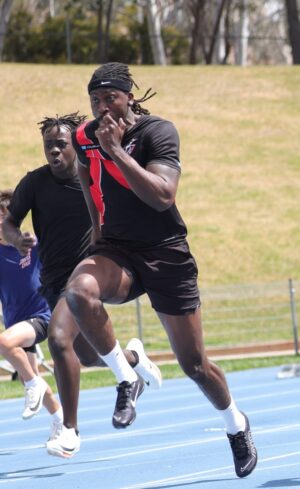
Featuring MSK Screening Insights Inspired by Dan Pfaff
At FAST Running, we believe performance begins with understanding the individual athlete—not just how fast they are, but how they move. This is why we integrate Musculoskeletal (MSK) screenings and biomechanical assessments into our coaching system, drawing on the world-renowned principles of elite sprint coach Dan Pfaff.
Whether you’re a shorter sprinter who thrives on frequency or a taller athlete with stride length to spare, your height influences every stride. Here’s how we tailor sprint development based on your body type—and how assessments help guide our approach.
Why MSK Screening Matters
Our partnership approach, influenced by Dan Pfaff’s detailed diagnostic methodology, starts with identifying:
- Mobility/flexibility limitations
- Structural asymmetries
- Stability deficits
- Movement efficiency patterns
These baseline screenings allow our coaches to build a performance plan rooted in your physiology—not generic programs. Every drill, gym movement, and cue is purposeful.
Shorter Sprinters: Speed Through Frequency and Power
Shorter sprinters typically produce faster stride turnover and require more steps to cover the same distance. Our focus areas include:
Stride Frequency and Ground Contact
- MSK Focus: Ankle and Achilles stiffness, metatarsal mobility, hamstring reactivity
- Drills to sharpen turnover while reducing ground contact time
Power-to-Weight Ratio
- Targeted strength work to maximize relative force and joint efficiency
Elasticity and Stiffness
- Plyometrics and bounding for ankle and knee stiffness development
- Core/postural circuits for midline control and energy transfer
Hip Projection & Drive Phase Efficiency
- MSK Focus: Hip flexor range, lumbar-pelvic control
- Technical sprint drills to enhance force direction and transition mechanics
Taller Sprinters: Harnessing Mechanics and Maximizing Range
Taller athletes often bring greater absolute power potential—but require precise mechanics to avoid wasted energy.
Optimised Mechanics
- MSK Focus: Thoracic rotation, scapular control, glute-hamstring coordination
- Sprint drills for arm-leg synchrony, upright posture, and relaxed turnover
Top-End Power Development
- Progressive gym loading to build strength without compromising speed
- Sprint sessions structured to maintain posture and force alignment
Mobility and Trunk Control
- MSK Focus: Hip stability, spinal alignment, rib cage dynamics
- Trunk control and mobility work to maintain rhythm in longer stride patterns
The FAST Running Philosophy
Inspired by the diagnostic rigour of Dan Pfaff and aligned with current best practices in sports performance, FAST Running offers:
- Individualised training informed by MSK screenings
- Biomechanically aware coaching tailored to sprinter body type
- Progressive strength & plyometric development
- Access to elite coaching and support from experienced mentors
We don’t just train sprinters. We build athletes for life.
Whether you’re entering from football, starting fresh at uni, or chasing that next personal best—our evidence-based system helps you run smarter, faster, and more efficiently.
Interested in joining the squad or booking your own performance screen?
📧 Get in touch via our contact page and take your next step toward running excellence.
| Category | Shorter Sprinter | Taller Sprinter |
| Stride Length | Naturally shorter stride length; must increase stride frequency to maintain speed | Naturally longer stride length; can cover more ground per step |
| Stride Frequency | Typically higher cadence is required | May have slightly lower cadence due to limb length |
| Acceleration Phase | Often accelerates faster due to lower inertia and compact frame | May take longer to reach top speed due to longer limbs and mass |
| Ground Contact Time | Generally shorter contact time; faster force application needed | Slightly longer contact time; more time to generate force |
| Force Production | Must apply greater relative force quickly to compensate for shorter levers | Can generate greater absolute force but over a longer range of motion |
| Centre of Mass Control | Lower centre of mass; may offer greater balance and agility in acceleration | Higher centre of mass; may require more control to stabilize during movement |
| Limb Lever Lengths | Shorter levers may allow faster limb cycling but less mechanical advantage | Longer levers may give mechanical advantage for power but slower cycling |
| Top-End Speed | May peak earlier and plateau due to shorter stride length | Typically capable of higher absolute top-end speed |
| Technical Focus | Emphasis on stride frequency, posture, and force application | Emphasis on rhythm, efficient mechanics, and maximal force application |
| Injury Risk Profile | Lower load per step but higher frequency → potential overuse risk | Higher force per step → risk for hamstring, hip flexor, and joint-related injuries |

Comments are closed