
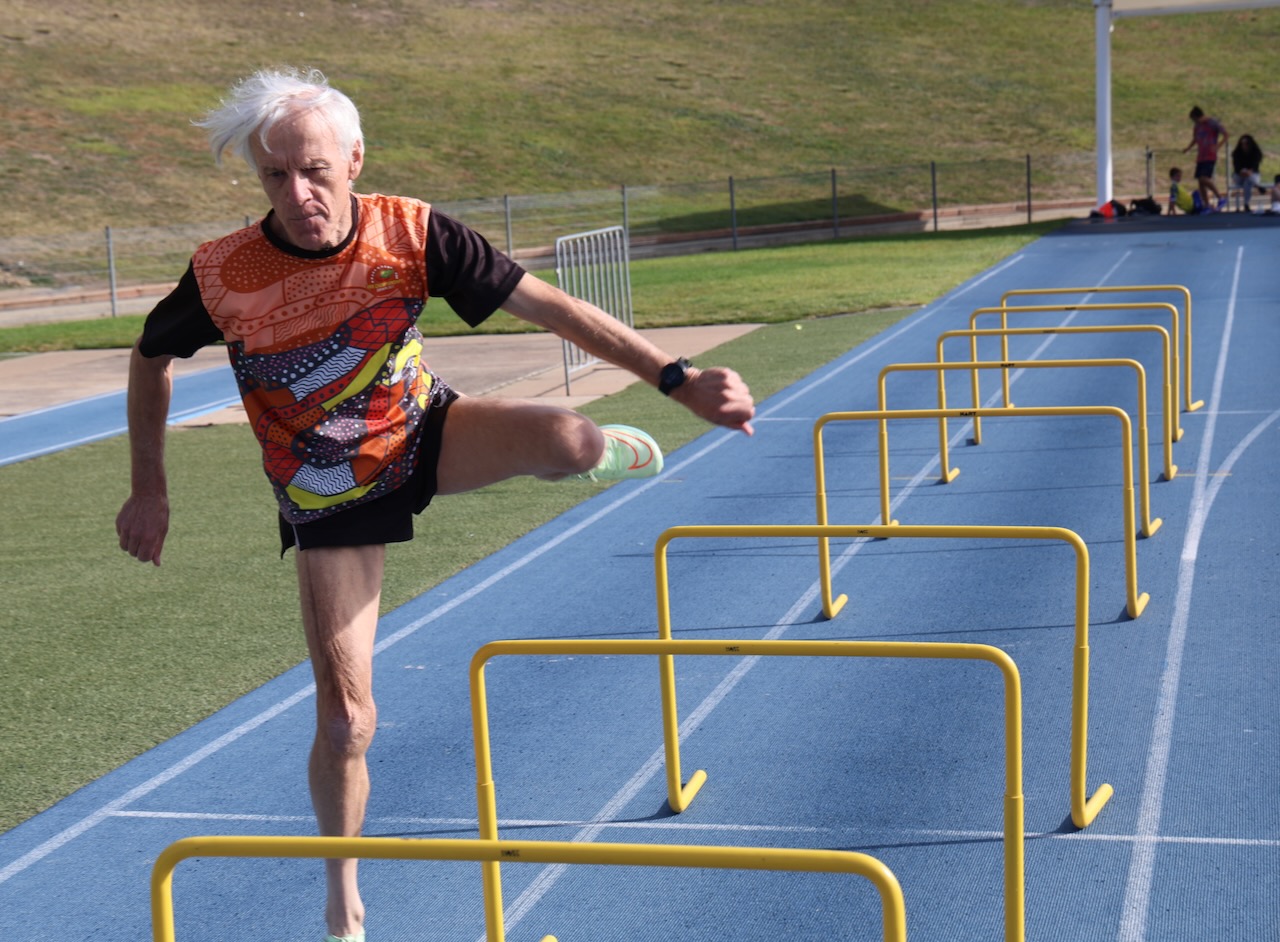
At FAST Running, age has never defined ambition.
And few athletes represent that better than John Lamb.
Following a breakthrough season that saw him run 15.25 seconds for the 80m hurdles on 10 March 2026 — setting a new Australian Record — the focus has now shifted toward something even bigger:
The World Masters Championships in Daegu, Korea from 22 August to 3 September 2026.
The immediate goal is clear.
Compete for medals.
But sitting further ahead is a far more ambitious target:
The World Record.
Currently held by American hurdler James Stookey at 13.62 seconds, the mark represents one of the highest standards in Masters hurdling.
And while records are never chased recklessly, FAST Running believes improvement begins by refusing to place artificial ceilings on performance.
Refining, Not Reinventing
At this stage of John’s development, the work is not about dramatic changes.
It is about refinement.
Small technical improvements that, over time, create meaningful gains:
- cleaner hurdle rhythm
- improved take-off distance
- reduced braking between hurdles
- better posture under fatigue
- more efficient lead and trail leg recovery
At the highest levels, tenths matter.
And in hurdling, tenths are often hidden inside rhythm and efficiency rather than effort alone.
Sprinting Between the Hurdles
One of the key principles guiding John’s preparation is simple:
Great hurdlers sprint first.
The objective is not merely to clear hurdles.
It is to maintain velocity through them.
This has led to an increased focus on:
- acceleration mechanics
- cadence between hurdles
- front-side mechanics
- stiffness and projection
- sprint posture under pressure
Because every improvement in sprint efficiency creates opportunities across the entire race.
Athlete First, Performance Driven
Masters athletes often face a unique challenge:
balancing performance ambition with recovery, durability, and longevity.
That balance shapes every aspect of John’s preparation.
Training is carefully structured to:
- maintain speed qualities
- manage load and recovery
- refine technical consistency
- avoid unnecessary fatigue accumulation
The objective is not simply to train harder.
It is to train smarter.
A Different Type of Leadership
One of the most powerful aspects of Masters athletics is visibility.
Younger athletes within FAST see athletes like John continuing to pursue ambitious goals with professionalism, consistency, and intent.
That matters.
It reinforces a culture where improvement does not stop with age.
And where standards remain high regardless of stage of life.
Daegu Ahead
The World Masters Championships now become the next major step in the journey.
An opportunity to test months of technical refinement and structured preparation against the best Masters hurdlers in the world.
A medal is within reach.
But so too is something larger:
Exploring just how fast John Lamb can still become.
At FAST Running, performance is never viewed as fixed.
Not at 18.
Not at 35.
And certainly not in Masters athletics.
Because improvement belongs to athletes willing to continue pursuing it.



Comments are closed