
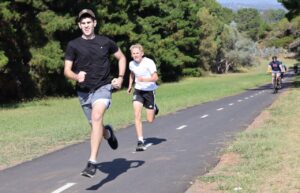
Nate Halpin (T01) has just returned from the Australian Championships in Adelaide, having competed in the Open Para Mens 100m, 200m, and Long Jump finals. Nate had a successful competition, his first, as an Open Aged athlete. He finished 10th overall in the Long Jump, and was the second fastest deaf athlete in the competition, and finished second in his 200m heat (25.61s) and fourth in his 100m heat (12.47s).
Nate’s performances this year are his fastest legal times at Nationals in his career. A significant performance given his return to sprinting was only at the end of September 2023, having focussed on his studies at the University of Canberra in recent times.
As a deaf athlete (T01), Nate is required to race without hearing aides, and relies on a light box to tell him when the gun has been fired. This is quite a disadvantage in terms of the start and acceleration phase. It also impacts the race plan of deaf athletes where they need to ignore the other competitors as they are not running on the same playing field.
Placings are determined on a classification system, which assesses the impact of an athlete’s impairment on their ability to perform in the sport. Athletes are grouped into different classes or categories based on the nature and severity of their impairment. Athletes with more severe impairments receive higher percentage adjustments to their times. Visually impaired athlete competing in a sprint event, for example, might receive a higher percentage adjustment to their time compared to an athlete with a less severe impairment, such as a limb deficiency.
At the Paralympics, athletes compete in their own classification. Deaf athletes do not compete at these championships. They instead can chose to race at the Deflympics. Nate is hoping to improve his personal bests over the next 9-12 months in order to qualify for Tokyo 2025.
Comments are closed