
The stopwatch rarely tells the whole story, and the 2026 ACT 13 Years and Over Track and Field Championships were a particularly good example.
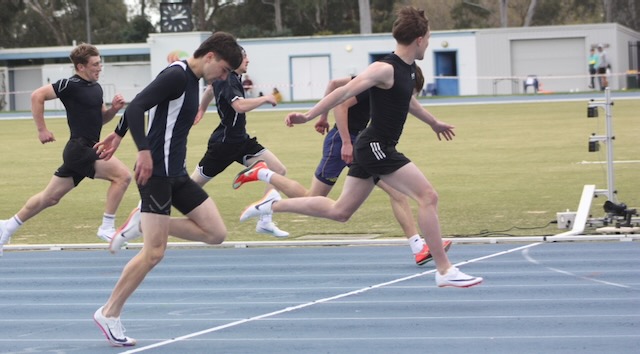
Canberra produced a cold day at the AIS on Tuesday, with gusty winds and headwinds affecting much of the sprint program. These weren’t the sort of conditions that normally produce a flood of fast times. In several events, athletes were running into winds exceeding one metre per second, and the leading 16-year boys’ 200m race was contested into a −2.9 m/s headwind.
Yet there was plenty for FAST Running to celebrate.
Twenty-three FAST athletes competed across the championships. There were championship victories and podium finishes, personal bests and significant improvements from the regional qualifying rounds, two ACT Championship Records, new FAST All-Time Top Ten performances and several performances that now sit among the best recorded at these championships.
There were also numerous top-two finishes that put FAST athletes into the qualification picture for the ACT team heading to the Australian All Schools Championships.
For some of our athletes, this was familiar territory. For others who have only recently joined FAST through this year’s school regional season, it was their first experience of an ACT Schools Championship.
Different athletes. Different expectations. Same opportunity to find out where they currently sit.
Four Wins and Two Records for Mikeire
If there was one performance that demanded attention, it belonged to Mikeire Hei Hei.
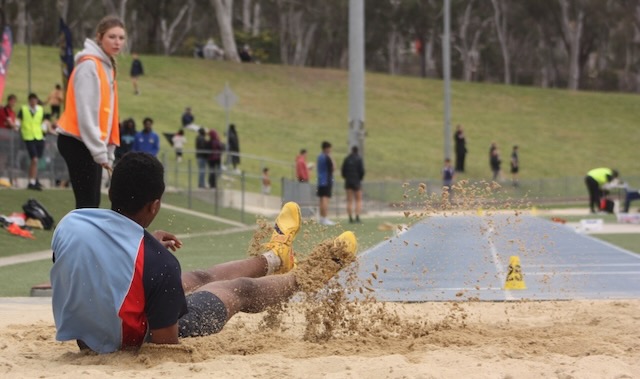
Mikeire won the 13-year boys’ 100m in 12.08 (-0.4) and the 200m in 25.16 (-1.1) before producing something even more significant in the horizontal jumps. His 5.65m Long Jump broke the existing ACT Championship Record of 5.50m, while his 11.86m Triple Jump broke the previous championship record of 11.63m.
Four events. Four first places. Two Championship Records.
Mikeire’s sprint performances also change the historical lists we published before Tuesday. His 12.08 moves into the historical Top 8 for the 13-year boys’ 100m, while 25.16 does the same over 200m.
Before the championships we asked, “Where do you sit?”
Mikeire gave us two new answers.
Annabelle Finds Speed on a Day That Wasn’t Giving Much Away
Annabelle Renda had already been steadily lowering her 100m performances through the early part of the season, but Tuesday provided another important step.
Her 13.35 into a −1.8 m/s headwind earned second place in the 16-year 100m. Then came one of the more impressive FAST performances of the afternoon: 27.06 (-0.4) to win the 200m, improving considerably on the 27.81 qualifying mark listed in the championship results. She also won the Long Jump with 4.85m.
The 200m also improves Annabelle’s position to 10th overall within the FAST performance rankings. Annabelle’s second top ten all time entry after the 100m.
Sometimes a PB comes on a warm day with a following breeze. Producing one in Tuesday’s conditions made this one particularly satisfying.
Emily Completes the Sprint Double
Emily Gaykema left with two championship victories.
She won the 14-year girls’ 100m in 13.25 (-0.2) and returned for 27.08 into a −1.5 m/s headwind to win the 200m.
Emily is one of the athletes who has* become part of the FAST environment during this school competition period, and her performances now also place her into the conversation within FAST’s age-group performance lists, Emily is now 7th in the 14-16 100m and 200m all time.
It is one of the enjoyable parts of this year’s championships: some of the names that first appeared through Regionals are already becoming much more familiar.
Afsa Shows Her Range
Few FAST athletes had a busier championship than Afsa Chowdhury.
Afsa finished third in the 15-year 100m in 13.81 and fourth in the 200m with 28.19, but the track represented only part of her day. She cleared 1.37m for second in the High Jump, then won the Long Jump with 5.03m and Triple Jump with 10.27m. Her long jump was a sizeable improvement on the 4.72m qualifying mark shown in the championship results.
Three podium finishes in the field, including two victories, plus another podium on the track says plenty about Afsa’s versatility.
Bree and Isabelle Turn Regional Qualification Into State Podiums
The 13-year girls provided another good example of the pathway from Regionals to the ACT Championships.
Isabelle Jeffs had run 13.44, 27.61 and 1:10.22 at the Northside Regionals. At State she finished second in the 100m (13.62 into −0.9), third in the 200m (28.24 into −0.6), and improved her 400m to 1:08.60 for fourth. The sprint times were slower, but the wind provides important context; the 400m represented a 1.62-second improvement from Regionals.
Alongside her, Bree Madigan Wong was third in the 100m with 13.67, second in the 200m with 28.07, and then won both horizontal jumps — 4.76m Long Jump and 9.82m Triple Jump.
Between them, Bree and Isabelle accumulated seven Top 4 finishes at their first championship together as part of this emerging FAST Females group.
Cecilia Adds Two More Podiums — and Enters the History List
Cecilia Ador finished second in both 17-year sprint events, running 13.27 (+0.3) in the 100m and 26.14 (+0.3) in the 200m.
The raw times don’t tell the full story of Cecilia’s year. Her preparation has included an extended interruption before gradually rebuilding her tolerance to full-speed sprinting.
Her 200m also does something interesting when Tuesday’s results are placed alongside the historical ACT Championship data: 26.14 moves into the historical Top 8 for 17-year girls.
That is exactly why we created those lists. They give current performances a historical reference point rather than looking at each championship in isolation.
Daniel and Sam Go One-Two — Twice
At the experienced end of the FAST group, Daniel Nwaobi and Sam Blood produced matching one-two finishes in the 17-year boys’ sprints.
Daniel won the 100m in 11.25 (-0.3) and 200m in 22.74 (-0.6). Sam was second in 11.61 (-1.5) before running 22.95 (-0.6) for second in the 200m.
There is useful context behind both performances. Daniel came into the championships after managing recent hamstring soreness. Sam’s preparation has been interrupted substantially by his return from injury.
Neither therefore needed Tuesday to become a desperate chase for a PB.
They needed to race.
They finished one-two in both events.
And all three of those 17-year performances — Daniel’s 11.25 and 22.74 and Sam’s 22.95 — are significant when compared with the ACT Championship history we compiled before the meet. Daniel now enters the historical 17-year Top 8 in both sprints, while Sam enters it over 200m.
Mitchell Makes One of the Biggest Improvements
One of the quieter results deserves some attention.
Mitchell Aleksandrowicz came into the 15-year 200m with a listed qualifying mark of 25.51.
At the ACT Championships he ran 24.68 (-0.1).
That’s an improvement of 0.83 seconds from the championship seed mark and moved him all the way to third place in the ACT. He also finished second in the 100m, sharing 12.11 with Lewin Ainsworth on time.
That is exactly the sort of progression worth noticing when looking beyond who had the fastest absolute performances.
Lewin Keeps Finding the Podium
Lewin Ainsworth had three Top 3 finishes across the 15-year sprints.
He was third in the 100m (12.11), second in the 200m (24.52) and second in the 400m (56.25). The 400m improved on his listed 56.70 qualifying mark.
These weren’t Lewin’s fastest performances — his established PBs sit well beyond them — but championships aren’t always about reproducing a PB. Three podium finishes on a difficult day is a worthwhile outcome.
Bradley Steps Forward From Regionals
Bradley Davis provided another clear example of progression through the school championship pathway.
His listed qualifying marks were 13.04 for 100m and 27.28 for 200m. At State, he ran 12.91 into a −0.4 headwind for fifth and 26.74 into −1.1 for fourth.
That’s an improvement of 0.13 in the 100m and 0.54 in the 200m, despite the headwinds.
Bradley also finished sixth in the discus with 23.99m, improving from his listed 21.70m qualifying mark.
Three events and three Top 6 finishes is a strong first State Championships story.
Isaac Turns Qualification Into Three State Top Tens
Isaac Simon deserves his place in the story too.
Isaac finished eighth in the 15-year 100m (12.58), sixth in the 200m (25.30), eighth in the 400m (1:03.60), fifth in the Long Jump (5.22m) and ninth in the High Jump at 1.55m.
The 200m was effectively level with his 25.31 qualifying mark, despite the championship setting, while his Long Jump placed him comfortably inside the ACT Top 8.
For an athlete coming through this year’s school pathway, that breadth is worth recognising.
Ewan Wins, Shiloh and Justin Deliver in the Jumps
The 16-year boys produced another cluster of FAST performances.
Ewan McElhinney won the 100m in 11.75 into a −1.2 headwind. Justin Akachili finished fifth in 12.11, while Shiloh Reid was eighth.
The order changed when they moved to the field.
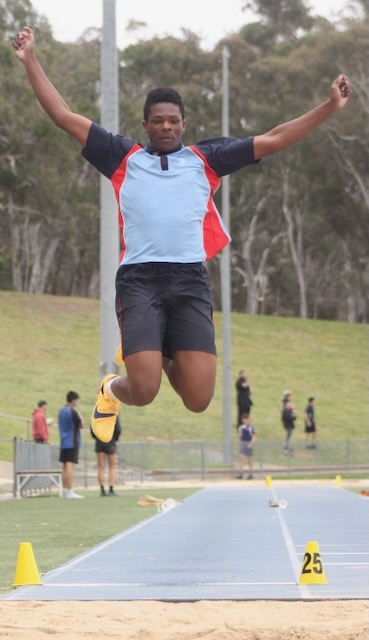
Shiloh won the Long Jump with 6.06m, improving on his listed 5.96m qualifying mark. Justin finished second with 5.89m, then won the Triple Jump with 11.76m, improving on the 11.62m listed entering the championships.
Justin also ran 24.59 for fifth in a 200m contested into that extraordinary −2.9 m/s headwind.
Those are exactly the performances for which looking only at the raw time would miss part of the story.
Ryan, Seth and the Jumping Group
Ryan Bhaskar finished second in the 15-year Long Jump with 5.66m, giving him a top-two result and another potential route towards ACT representation.
Seth Samarakoon finished sixth in the 14-year 100m before producing a much stronger outcome in the Triple Jump. His championship entry mark was 9.80m; at State he jumped 10.40m for third — a 60cm improvement on that qualifying mark.
Among the 13-year boys, Archer Lindner finished sixth in the Long Jump with 4.40m, while Sam Ainsworth was seventh with 4.39m, putting both inside the ACT Top 8.
Clare’s Championship Is Bigger Than Tuesday
Clare Rice finished sixth in the 13-year Long Jump with 4.19m and fourth in the Triple Jump with 8.86m.
But Tuesday represents only part of Clare’s school championship campaign.
At High Noon she had already contested the events that weren’t available through the standard Tuesday program, including her first 2000m Steeplechase (10:27.14) and the 3000m Race Walk (20:01.56), giving her additional performances in the ACT qualification picture.
For a 13-year-old who is still relatively new to FAST, moving between steeplechase, race walking and horizontal jumps is quite a championship experience.
Brooklyn’s Qualification Story Also Started Earlier
The same applies to Brooklyn Montana.
On Tuesday Brooklyn was third in the 17-year 100m (12.28), third in the Long Jump (5.38m) and won the Triple Jump with 11.57m.
But Brooklyn had already added a hurdles qualifying performance at High Noon.
That broader picture matters. For some athletes, Australian All Schools qualification came down to Tuesday. For others, the pathway was built across multiple nominated competitions.
More Than the Podiums
Not everyone needs to stand in the first three for a championship to represent progress.
Jasmine Smyth competed in the 15-year 200m and Long Jump, finishing tenth in both. For athletes experiencing this level of school competition for the first time, simply progressing from Regionals to sharing the State Championship with the ACT’s strongest school athletes is another step in the development pathway. Her 30.34s 200m came in a race where the wind was favourable at +0.9.
That same perspective applies across the FAST contingent. Some arrived with national championship experience. Some arrived chasing ACT selection. Some were at their first ACT Schools Championships after only recently joining FAST.
Those athletes shouldn’t all be judged against the same definition of success.
From Regionals to State
One of the most encouraging parts of the championship was seeing athletes take performances from the regional level and improve them when the competition became stronger.
Among the clearest examples from the published championship qualifying marks were Mitchell Aleksandrowicz, 25.51 → 24.68 over 200m; Bradley Davis, 13.04 → 12.91 and 27.28 → 26.74; Annabelle Renda, 27.81 → 27.06; Seth Samarakoon, 9.80m → 10.40m in Triple Jump; Shiloh Reid, 5.96m → 6.06m in Long Jump; Justin Akachili, 11.62m → 11.76m in Triple Jump; and Isabelle Jeffs, 1:10.22 → 1:08.60 over 400m.
Not every regional mark should automatically be treated as a PB, and the championship seed column isn’t necessarily a complete record of an athlete’s personal best. But it does provide a useful picture of athletes progressing from qualification into the ACT Championship itself.
That progression matters.
A Lot of Top-Eight Performances
Podiums naturally attract attention, but State Top 8 finishes are also significant.
Across the championships FAST athletes appeared repeatedly inside the top eight — sometimes across several disciplines. Bree had four Top 3 finishes. Afsa had five Top 4 finishes. Mikeire won four events. Annabelle had three Top 2 finishes. Isabelle finished inside the Top 4 three times. Lewin made the Top 3 in all three of his sprint events. Bradley was Top 6 across sprinting and throwing. Isaac Simon made the Top 8 in four events. Shiloh, Justin, Ryan, Seth, Archer and Sam added further jumping Top 8s.
That breadth is perhaps a better measure of the FAST presence at these championships than counting victories alone.
The Historical Lists Have Already Changed
The day before the championships, FAST published more than a decade of ACT Championship 100m and 200m results and asked a simple question:
Where do you sit?
Twenty-four hours later, the answer changed.
Among Tuesday’s performances, Mikeire Hei Hei’s 12.08 and 25.16, Daniel Nwaobi’s 11.25 and 22.74, Cecilia Ador’s 26.14 and Sam Blood’s 22.95 all enter the historical ACT Championship Top 8 for their respective age groups and events based on the results FAST has compiled.
That’s one of the things we hoped the historical project would do. These aren’t just numbers from an old results file anymore. Current athletes can see the names that came before them — and occasionally put their own name among them.
The FAST Top Ten Moves Too
Tuesday also changes FAST’s own performance history.
Several of the newer athletes now enter or improve positions within the FAST age-group rankings, while performances such as Annabelle’s 27.06 strengthen her position among the club’s fastest female 200m runners. Two of the newest additions are Bradley Davis and Justin Akachili, who recorded performances good enough to become new entrants to the FAST Top Ten.
Those rankings aren’t intended to tell us who has the most potential. They tell us something much simpler: what has actually been achieved.
As the squad grows, making those lists should become harder.
That’s a good thing.
And Now, the ACT Team
For a significant group, Tuesday may also lead somewhere else.
Finishing in the first two in an event puts a number of FAST athletes into the ACT qualification picture for the Australian All Schools Championships, subject to the final selection requirements and confirmation of the team.
Rather than declaring the team before that process is complete, we’ll wait for the official announcement.
But there are plenty of FAST names in the conversation.
Bree Madigan Wong, Isabelle Jeffs, Emily Gaykema, Afsa Chowdhury, Annabelle Renda, Cecilia Ador, Mikeire Hei Hei, Mitchell Aleksandrowicz, Lewin Ainsworth, Ewan McElhinney, Justin Akachili, Shiloh Reid, Ryan Bhaskar, Daniel Nwaobi and Samuel Blood all recorded top-two finishes on Tuesday in at least one event. Brooklyn Montana and Clare Rice also bring performances from the additional qualifying opportunities at High Noon.
For some, an ACT uniform would be familiar.
For others, it would represent another significant first.
Twenty-Three Athletes. Twenty-Three Different Stories.
The FAST athletes competing at the 2026 ACT 13 Years and Over Championships were Bree Madigan Wong, Isabelle Jeffs, Emily Gaykema, Afsa Chowdhury, Annabelle Renda, Cecilia Ador, Clare Rice, Jasmine Smyth, Mikeire Hei Hei, Bradley Davis, Seth Samarakoon, Mitchell Aleksandrowicz, Lewin Ainsworth, Isaac Simon, Ewan McElhinney, Justin Akachili, Shiloh Reid, Ryan Bhaskar, Daniel Nwaobi, Samuel Blood, Brooklyn Montana, Archer Lindner and Sam Ainsworth.
Some won events. Some stood on the podium. Some produced PBs. Some improved significantly from Regionals. Some moved into FAST or ACT historical rankings. Some put themselves into contention for an ACT uniform.
And for some, simply getting through Regionals and arriving at their first ACT Schools Championship was the achievement.
The conditions weren’t particularly glamorous. It was cold. The wind wasn’t especially interested in helping anyone run quickly. Not every athlete got the result they wanted.
That’s sport.
The useful question isn’t whether every performance was good. It is what each athlete can learn from it and what comes next.
A day earlier, we asked our athletes to look backwards through ACT Championship history and consider where they sat.
Now the class of 2026 is part of that history too.
Yesterday’s performance tells us something about where an athlete is today. It does not tell us where they will finish.
FAST Performance | Centre of Running Excellence
Real data. Better understanding. Better coaching.
Running Excellence grows.
FAST Results — 2026 ACT 13 Years & Over Championships
Girls
Bree Madigan Wong — 13 Years
100m — 13.67 (-0.9) — 3rd
200m — 28.07 (-0.6) — 2nd
Long Jump — 4.76m — 1st
Triple Jump — 9.82m — 1st
Isabelle Jeffs — 13 Years
100m — 13.62 (-0.9) — 2nd
200m — 28.24 (-0.6) — 3rd
400m — 1:08.60 — 4th
Emily Gaykema — 14 Years
100m — 13.25 (-0.2) — 1st
200m — 27.08 (-1.5) — 1st
Afsa Chowdhury — 15 Years
100m — 13.81 — 3rd
200m — 28.19 (+1.4) — 4th
High Jump — 1.37m — 2nd
Long Jump — 5.03m — 1st
Triple Jump — 10.27m — 1st
Jasmine Smyth — 15 Years
200m — 30.34 (+0.9) — 10th
Long Jump — 3.82m — 10th
Annabelle Renda — 16 Years
100m — 13.35 (-1.8) — 2nd
200m — 27.06 (-0.4) — 1st
Long Jump — 4.85m — 1st
Cecilia Ador — 17 Years
100m — 13.27 (+0.3) — 2nd
200m — 26.14 (+0.3) — 2nd
Clare Rice — 13 Years
Long Jump — 4.19m — 6th
Triple Jump — 8.86m — 4th
Boys
Mikeire Hei Hei — 13 Years
100m — 12.08 (-0.4) — 1st
200m — 25.16 (-1.1) — 1st
Long Jump — 5.65m — 1st — ACT Championship Record
Triple Jump — 11.86m — 1st — ACT Championship Record
Bradley Davis — 13 Years
100m — 12.91 (-0.4) — 5th
200m — 26.74 (-1.1) — 4th
Discus — 23.99m — 6th
Archer Lindner — 13 Years
Long Jump — 4.40m — 6th
Sam Ainsworth — 13 Years
Long Jump — 4.39m — 7th
Seth Samarakoon — 14 Years
100m — 12.96 (+0.4) — 6th
Triple Jump — 10.40m — 3rd
Mitchell Aleksandrowicz — 15 Years
100m — 12.11 (-0.2) — 2nd
200m — 24.68 (-0.1) — 3rd
Lewin Ainsworth — 15 Years
100m — 12.11 (-0.2) — 3rd
200m — 24.52 (-0.1) — 2nd
400m — 56.25 — 2nd
Isaac Simon — 15 Years
100m — 12.58 (-0.2) — 8th
200m — 25.30 (-0.1) — 6th
400m — 1:03.60 — 8th
High Jump — 1.55m — 9th
Long Jump — 5.22m — 5th
Ryan Bhaskar — 15 Years
100m — 12.81 (-1.6) — 11th
Long Jump — 5.66m — 2nd
Ewan McElhinney — 16 Years
100m — 11.75 (-1.2) — 1st
Justin Akachili — 16 Years
100m — 12.11 (-1.2) — 5th
200m — 24.59 (-2.9) — 5th
Long Jump — 5.89m — 2nd
Triple Jump — 11.76m — 1st
Shiloh Reid — 16 Years
100m — 12.67 (NWI) — 8th
High Jump — 1.55m — =8th
Long Jump — 6.06m — 1st
Daniel Nwaobi — 17 Years
100m — 11.25 (-0.3) — 1st
200m — 22.74 (-0.6) — 1st
Samuel Blood — 17 Years
100m — 11.61 (-1.5) — 2nd
200m — 22.95 (-0.6) — 2nd
Brooklyn Montana — 17 Years
100m — 12.28 (-0.3) — 3rd
Long Jump — 5.38m — 3rd
Triple Jump — 11.57m — 1st
Comments are closed