
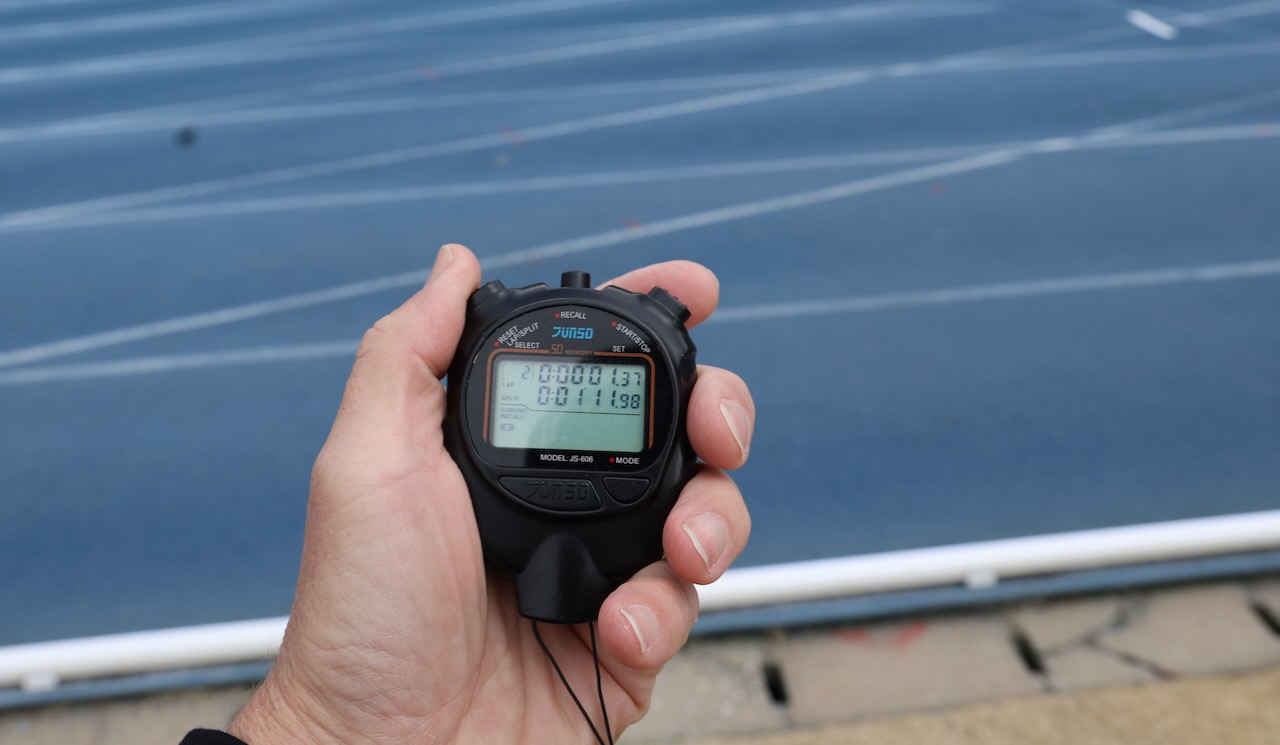
Athletics has an appealing simplicity.
Eventually somebody starts the clock.
An athlete runs from one point to another and a number appears. Run faster than last week and you have improved. Run faster than everyone else and you win.
For a sport increasingly surrounded by biomechanics, wearable technology and performance data, that basic measurement has remained remarkably unchanged. More than a century after electronic timing first appeared, the stopwatch is still the ultimate judge of performance.
At FAST Running, we value that simplicity. We electronically time flying sprints, accelerations and longer runs throughout the year. We record performances, compare sessions and build a history of every athlete’s development. Over time, those numbers become incredibly valuable because they show us trends that memory alone could never capture.
But the longer we have measured performance, the more one lesson has stood out.
The stopwatch tells us exactly what happened.
It rarely tells us why.
That is where coaching begins.
Looking Beyond the Number
Imagine two athletes both recording exactly 2.30 seconds for a Flying 20 metres.
On paper, the performances are identical.
Standing beside the track, they may have looked completely different.
One athlete may have sprinted with relaxed shoulders, strong posture and excellent front-side mechanics. The other may have reached desperately for every stride, over-rotated through the trunk and produced the same time largely through determination rather than efficiency.
The stopwatch records one number.
The coach sees two very different athletes.
The same principle applies over longer periods of development. An athlete returning from injury may deliberately run below maximum effort while another is chasing a personal best. One athlete may be adapting to a new technical model, temporarily sacrificing speed while learning a more efficient movement pattern. Another may have reached a plateau despite continuing to record similar times.
If we coached purely from the stopwatch, we would treat those athletes the same.
They are not the same.
Building a History, Not a Leaderboard
Over the past year, FAST Running has invested considerable time in building what has become our Athlete Performance Repository.
On the surface, it is simply a collection of sprint times. Flying 20s, Flying 30s, standing accelerations, speed endurance runs and competition performances recorded across multiple seasons.
The value of the repository, however, is not in identifying who was fastest on a particular Tuesday evening.
Its value comes from revealing patterns.
We might see an athlete’s Flying 20 improving steadily months before their 100-metre personal best falls. Another athlete may suddenly accelerate much better over the first 30 metres while maximum velocity remains unchanged, suggesting the next phase of training should focus elsewhere. A younger athlete might not yet be running spectacular times, but their progression over twelve months may indicate enormous long-term potential.
None of those observations comes from a single session.
They come from patiently collecting information over time and asking what the numbers are really telling us.
Performance is rarely one data point.
It is a story.
Data Should Challenge Coaches Too
Good coaches observe.
Experienced coaches often develop strong instincts about how athletes are progressing.
The danger is that instinct, on its own, can sometimes be misleading.
We all remember spectacular performances. We all remember difficult sessions. Gradual improvement, however, is surprisingly easy to miss because we witness it every week.
That is where objective measurement becomes invaluable.
Sometimes the data confirms exactly what we expected.
Sometimes it tells a different story.
An athlete who feels frustrated by a slow winter may actually be running consistently better than they were twelve months earlier. Another may appear to be sprinting beautifully, yet their performance data suggests that technical improvements are not yet transferring into faster times.
Neither observation is automatically right.
The important question is why they differ.
Perhaps the athlete is carrying fatigue. Perhaps environmental conditions have changed. Perhaps training priorities have shifted. Occasionally, perhaps our coaching assumption was simply wrong.
That possibility should never threaten a coach.
It should excite them.
The best coaches do not use data to prove themselves right.
They use it to become better.
What We Cannot Measure
Some of the most important developments we see at FAST Running never appear on a spreadsheet.
A young athlete who finally attacks the ground with confidence after months of tentative sprinting.
An experienced sprinter who learns to stay relaxed under pressure.
An athlete returning from injury who stops subconsciously protecting the previously injured leg.
A teenager who arrives early, helps set up equipment and quietly becomes a leader within the squad.
None of these moments produces a faster Flying 20 that evening.
All of them matter.
If coaching becomes nothing more than collecting numbers, we risk overlooking many of the qualities that allow athletes to thrive over the long term.
Confidence.
Resilience.
Decision-making.
Leadership.
The willingness to trust a process even when immediate improvement is not obvious.
Those qualities are far more difficult to measure than sprint times, yet they often determine who continues improving year after year.
Athlete First, Always
This becomes particularly important when athletes are returning from injury.
There are sessions at FAST where an athlete is deliberately instructed to run at 75, 80 or 90 per cent effort. The stopwatch tells us they are slower than usual.
That is exactly what we expected.
The purpose of the session is not to produce a personal best. It is to rebuild capacity, restore confidence and gradually prepare the athlete for full training again.
A coach who looked only at the time would conclude the session had been unsuccessful.
A coach who understood the purpose would recognise it as an important step forward.
That is why Athlete First sits at the centre of everything we do.
Performance always matters.
Long-term development matters more.
More Than a Number
Technology will continue to become more sophisticated. Timing systems will improve. Cameras will capture more detail. Performance databases will become richer and more insightful.
FAST Running will continue embracing those tools because they help us become better coaches.
But they will never replace coaching itself.
Behind every personal best is a far more interesting story than the stopwatch can ever record. There are hundreds of training sessions, technical changes, conversations, setbacks, adjustments and small decisions that shaped the final result.
The stopwatch captures the final chapter.
Our responsibility as coaches is to understand the entire book.
Comments are closed