
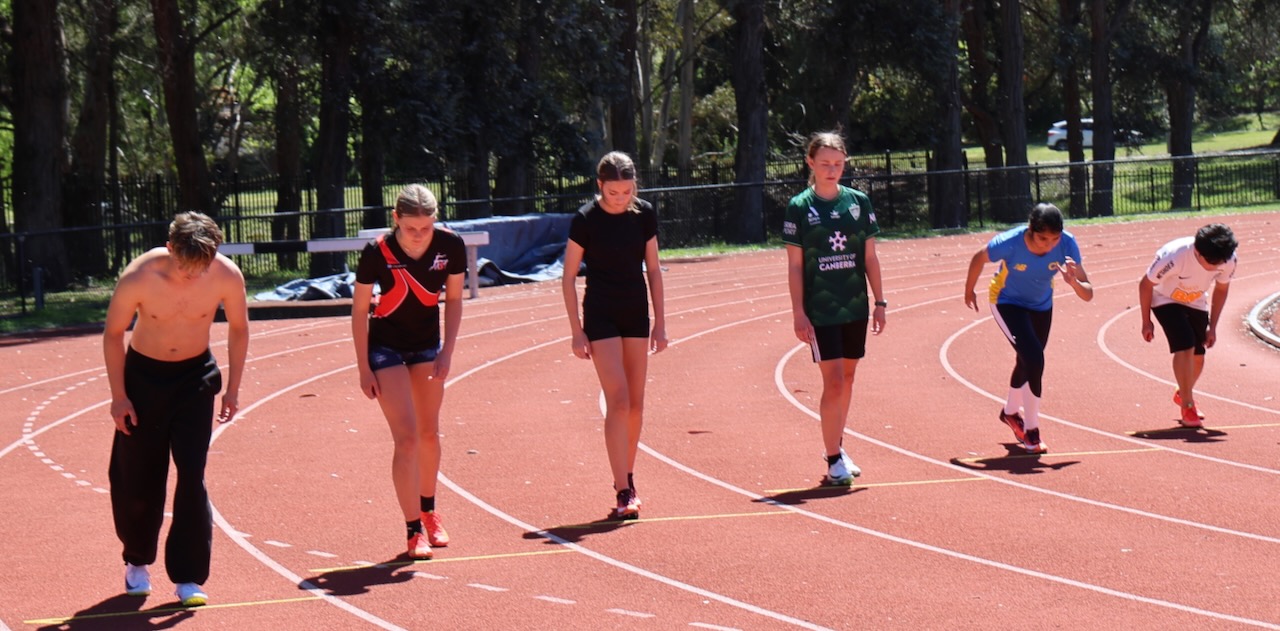
A week after leaving the AIS, FAST returned to a synthetic track for blocks, maximum velocity, hurdles, jumps, sporting speed and another opportunity to measure progress.
A week can be a long time in athletics.
Seven days earlier, FAST Running was beginning the process of rebuilding its training week after leaving the AIS. Cook and Aranda were becoming our new grass training grounds, equipment was moving around Canberra with our coaches, and athletes were learning what their new weekly routine would look like.
By Sunday morning, the final piece was in place.
Woden Park welcomed FAST for our first Sunday session at what will become our regular synthetic-track home for the coming months. After three grass sessions during the week and our traditional Saturday morning hill session at GG’s, returning to a track brought a familiar feeling to the end of a very unfamiliar week.
It didn’t take long for Woden to feel like ours.
Making Sunday count
Regular access to a synthetic surface remains important to the way FAST develops athletes, particularly as the summer competition season begins.
That doesn’t mean every athlete arrives at Woden and completes the same session. Quite the opposite.
Sunday included block acceleration, maximum-velocity work, hurdles and horizontal jumps, while our FAST for Sport athletes continued developing the speed qualities required for their own sports. Individualised overlays sat across the broader program for athletes whose event, competition schedule, development or physical needs required something different.
That is increasingly the FAST model.
We begin with our common FAST Foundation, build event and knowledge-specific training on top of it, and then individualise where the athlete requires it. Having access to Woden gives our coaches another environment in which to deliver that model properly.
The synthetic surface is particularly valuable for the qualities that become increasingly important as athletes move towards competition: higher velocities, event-specific contacts, block work, hurdling, jumping and objective performance measurement.
Sunday gave us all of those things.
The timing gates tell another part of the story
One of the most interesting parts of the morning came from a simple 30 metres of track.
Our Flying 30m testing gives us an objective measure of maximum-velocity performance. Athletes build into the timing zone before running 30 metres at speed, allowing us to track one of the qualities that matters enormously to our sprinters and increasingly to athletes from other sports.
We have been collecting these performances throughout the year, which means Sunday’s results weren’t simply numbers appearing on a screen. We had something meaningful against which to compare them.
And several athletes moved forward.
Aqlan produced one of the most substantial changes, taking 0.17 seconds from his previous September Flying 30m performance. Over a 30-metre maximum-velocity zone, that is not a trivial improvement.
Isabelle also improved by 0.17 seconds from her previous September benchmark, another significant movement over such a short distance.
Sam lowered his previous electronically recorded Flying 30m mark by 0.06 seconds, while Lewin also improved by 0.06 seconds from his September result. Sanjna made the same 0.06-second progression from her previous Flying 30m benchmark.
Cecilia matched her previous best performance exactly, while Emily, Jasmine and Afsa all recorded strong Flying 30m performances that now give us valuable benchmarks as we continue tracking their development.
And that matters to us.
Competition results deserve recognition, but progress doesn’t suddenly become less important because there isn’t a starter, a finish-line camera or a medal involved.
An athlete who has worked for weeks and finds another six hundredths of a second deserves to know it. An improvement of seventeen hundredths over 30 metres deserves to be recognised. Matching a strong previous performance tells us something too.
Progress is progress.
Why hundredths matter
Outside sprinting, 0.06 seconds sounds almost absurdly small.
Within sprinting, it can be significant.
The purpose isn’t to celebrate every fluctuation in a timing-gate result as evidence of a breakthrough. Performance varies from day to day, which is precisely why FAST keeps records over time rather than treating an isolated number as definitive.
What becomes useful is the pattern.
When athletes repeatedly produce stronger performances, when the timing data moves in the same direction as the technical changes coaches are observing, and when those improvements begin appearing in competition, we have better evidence that the program is doing what we want it to do.
That is why measurement is part of our coaching rather than an occasional novelty.
We aren’t timing athletes simply to rank them against one another. The most useful comparison is often the athlete standing on the track today against the athlete who ran through the same timing gates weeks or months earlier.
Aqlan doesn’t need somebody else’s Flying 30m to tell him that taking 0.17 seconds from his own September performance is progress. Isabelle doesn’t either. Sam, Lewin and Sanjna have their own previous marks to chase.
The data belongs within the development process.
Real data. Better understanding. Better coaching.
Much more than a Flying 30
While the timing gates gave us some particularly satisfying numbers, they represented only one part of a busy Sunday morning.
Across Woden, athletes were leaving the blocks, developing maximum velocity, working over hurdles and refining horizontal jumps. FAST for Sport athletes were developing speed they can transfer back into their own sporting environments, while individualised programming allowed athletes with different requirements to train within the same squad environment.
That breadth is important.
FAST is no longer simply a group of athletes following one sprint session together. On any given morning we can have athletes from different age groups, different events, different sports and very different stages of development sharing the same facility.
The challenge is not merely accommodating that diversity. It is making it useful.
That requires programming, equipment and systems, but most of all it requires coaches who understand what each athlete is trying to achieve.
Woden gives us an excellent environment in which to bring those pieces together.
Our first week is complete
By the end of Sunday, the new FAST week had completed its first full cycle.
Cook and Aranda gave us three sessions on grass. Saturday took us back to the hill at GG’s. Sunday brought us onto the synthetic track at Woden.
None of those environments needs to be something it isn’t.
Grass gives us opportunities that we can use deliberately. The hill provides a natural environment for acceleration, strength and event-specific conditioning. Woden gives us the surface and facilities for high-speed running, blocks, hurdles, jumping and precise performance measurement.
Rather than trying to recreate the AIS four or five times around Canberra, we are beginning to build a weekly system that takes advantage of what each location offers.
A week into that transition, athletes aren’t merely coping with it.
Some are already getting faster.
That might be seventeen hundredths of a second. It might be six hundredths. Sometimes it is simply matching a previous best while training continues around you.
Those moments deserve their place in the story too.
Competition gives athletes the opportunity to show everyone else what they can do.
Training is where much of the progress that makes those performances possible actually happens.
And on our first Sunday at Woden, the numbers gave several FAST athletes a little moment in the sun.
Our surroundings have changed. Our pursuit hasn’t.
Comments are closed