
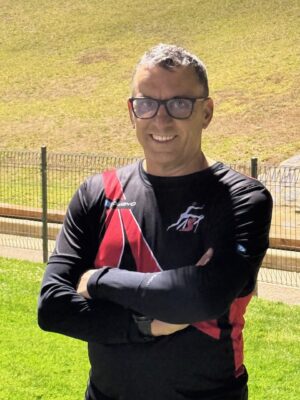
At 57, Peter Kent’s story with FAST Running is not defined by medals — but by resilience, reinvention, and a deep love for the sport that’s never left him.
A talented 400m hurdler in his youth, Peter returned to the track decades later through ACT Masters Athletics, driven by a quiet goal: to be competitive at the 2026 Australian Masters Championships in Canberra. But as Peter quickly discovered, coming back to sprinting in his fifties is not without its hurdles — both literal and physical.
“It seems I get injured every time I touch the track,” Peter admits with a smile. “But every time, there’s been a silver lining. There’s always something positive to take away.”
His journey has included setbacks many would find insurmountable: recurring calf strains, chronic stiffness in his right ankle and hip, thoracic spine immobility, an ACL injury from when he was 17 that still limits his left knee movement, and Achilles tendon flare-ups after a 200m race last season. Yet Peter keeps showing up — to training, to strength sessions, to Parkrun on Saturdays (even if he’s walking), and to Clinic 88 appointments that help him slowly untangle the web of compensations in his body.
“I can jog forever without a problem,” he says. “But it’s going fast where things fall apart. That’s why I sought coaching — to train smart, not just hard.”
Peter’s approach is as thoughtful as it is determined. He’s committed to a twice-weekly strength program that’s built significant ankle and leg resilience. His Tuesdays and Thursdays are spent at FAST Running sessions, often modifying drills to suit his body while staying engaged in technical and mobility work. Even when side-lined from full-speed training, Peter uses walking hurdle drills to maintain his hip mobility — and his connection to the sport he loves.
With support from Clinic 88 and a tailored action plan from the FAST coaches, Peter’s making progress — not only physically, but mentally. Video feedback and movement assessments have helped him build awareness around movement quality, asymmetries, and where compensations creep in.
And when it comes to running, his benchmark isn’t medals — it’s movement. For Peter, running a Parkrun without pain, completing a full warm-up with control, or getting through drills without triggering flare-ups is the success story.
“I see Parkrun as my fitness test,” he explains. “If I can do that consistently, I know I’m ready to push the pace again.”
Away from the stopwatch, Peter has another unique claim to fame: as a teenager, he appeared as an extra in the acclaimed ABC/BBC miniseries The Four Minute Mile, which told the story of Roger Bannister and John Landy’s historic race. You can spot him in two scenes — one running, the other in the change room. He jokes that you can tell who isn’t an actor by how starstruck he looks as the leads walk past.
It’s a fitting cameo. Like the legends of the mile, Peter’s own journey is one of grit, grace, and the courage to keep showing up — not for glory, but for growth.
Why We Celebrate Peter
Peter reminds us that success in athletics isn’t always about PBs or podiums. It’s about persistence. It’s about the deep satisfaction that comes from improving, adapting, and staying connected to the sport you love — no matter your age or history.
At FAST Running, we’re proud to support Peter’s journey and to coach athletes who define excellence on their own terms.
Comments are closed