
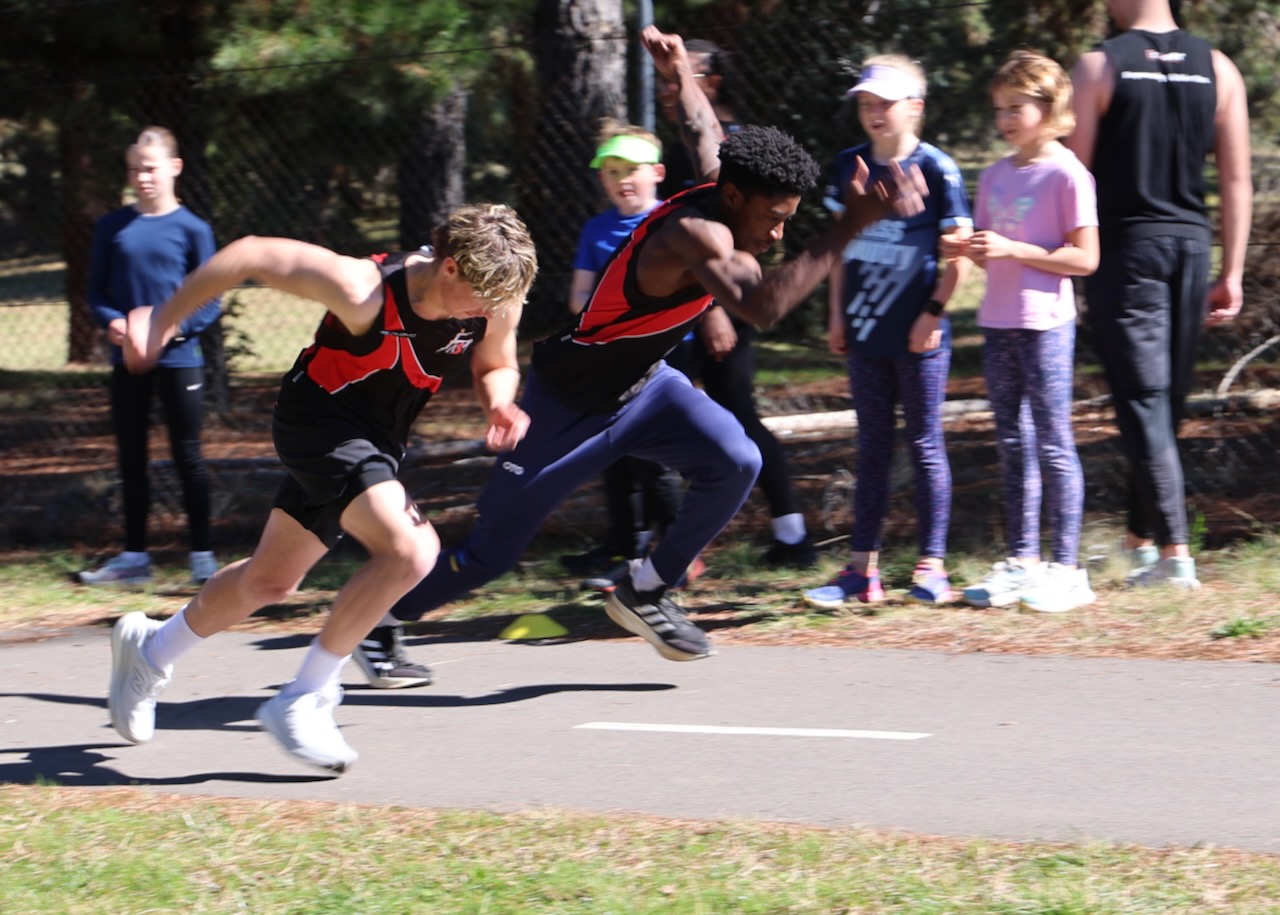
Every time a FAST athlete steps onto the track, the clock gives us a number.
Most of those numbers belong to a particular moment. They tell us how an athlete performed on that day, in those conditions, at that stage of their development. Some become personal bests. Some represent breakthroughs that an athlete has worked months or years to achieve.
And occasionally, a performance earns an athlete a place in FAST history.
Over more than a decade, hundreds of athletes have trained with FAST at different ages and stages of their development. Thousands of performances have been recorded along the way.
Our FAST Top Ten Performances bring some of that history together.
The rankings recognise our fastest performances across the 100m, 200m and 400m, with separate male and female lists and age-group rankings for 11–13, 14–15 and 16–18, alongside our All-Time lists.
They give today’s athletes something to chase. But perhaps more importantly, they allow us to look backwards and see something that a single result can never show us.
Development.
A Ranking Is a Moment, Not a Destination
We believe performances should be celebrated.
Running fast matters. Setting a personal best matters. Winning matters. And earning a place among the fastest athletes to have trained with FAST should mean something.
But a Top Ten ranking is not a prediction of potential.
This distinction becomes particularly important when looking at younger athletes.
An athlete ranked first at 12 is not guaranteed to be first at 16. An athlete sitting tenth may eventually become considerably faster than everyone currently ahead of them. Another athlete may not appear on a younger-age list at all before developing rapidly later.
Our own research into ACT athlete development has reinforced this. Early performance contains information. It just doesn’t contain destiny.
The FAST Top Ten provides some wonderful real-world examples.
Watching a Sprinter Grow
Daniel Nwaobi’s name appears throughout the rankings.
At ages 11–13, Daniel recorded 11.70 for 100m, a performance that remains at the top of the FAST ranking for that age group.
By 14–15, he had improved to 11.41.
At 16–18, Daniel ran 10.88.
That performance now places him second on the FAST All-Time men’s 100m list.
His 200m progression tells a similar story. A 25.14 performance in the 11–13 rankings became 23.11 at 14–15 and eventually 22.16, placing him second on our All-Time list.
Looking at the final number alone — 10.88 or 22.16 — hides most of the story.
Put the performances beside one another and we can begin to see the athlete developing.
Different Athletes, Different Pathways
Not every progression looks the same.
Rebecca Guest provides a wonderful example.
Her name appears across all three sprint distances and multiple age groups. In the 11–13 rankings she appears in the 100m and sits at or near the top of the 200m and 400m lists. Her name then continues through the older age categories.
Today, Rebecca remains in the FAST All-Time female Top Ten for the 100m, 200m and 400m.
Thomas Madigan’s progression through the 400m provides another perspective.
His 62.67 at ages 11–13 became 53.62 at 14–15 and eventually 51.05 at 16–18. That performance remains third on the FAST All-Time men’s 400m list.
Austin Tetteh appears across distances and age groups as well. His 12.59 100m performance from ages 11–13 eventually became 11.14, which remains among the fastest 100m performances in FAST history.
There isn’t one pathway represented by these lists.
There are many.
New Names Join the Story
The rankings aren’t only about looking backwards.
They continue to change.
Recently, Jungone Kang became one of the newest athletes to enter the FAST Top Ten, running 13.19 for 100m and 27.43 for 200m to enter both 11–13 boys’ rankings.
Those performances now sit alongside athletes who subsequently achieved some significant things in athletics.
But we don’t know what Jungone’s future performances will look like.
We don’t need to.
His performances tell us where he is now. They give him benchmarks, recognise what he has achieved and provide another point from which his development can continue.
In several years, perhaps we’ll look back at 13.19 and 27.43 and see the beginning of a remarkable progression.
Perhaps his journey will take an entirely different direction.
That’s the fascinating thing about developing athletes.
We get to find out.
The Standards Left Behind
The All-Time lists also provide another important part of FAST’s history.
Vivian Williams’ 10.58 currently leads the men’s 100m rankings. Natasha Martin’s 12.06 leads the women.
Over 200m, Vivian’s 21.89 and Cecilia Ador’s 25.12 set the current FAST standards.
For 400m, the marks are 48.21 for Haziq Saleem Deen and 58.48 for Baylee Fisher.
Those performances deserve recognition.
They also give every athlete who follows a visible representation of what athletes within the FAST environment have achieved before them.
Someone will eventually challenge them.
That’s how performance sport works.
More Than a Leaderboard
The FAST Top Ten isn’t intended to tell us who has the most potential.
It isn’t a selection list.
And particularly for our younger athletes, it should never become a reason to decide who will or won’t become successful.
It is something much simpler.
It is a record of performance.
It allows us to recognise athletes who have achieved high standards while preserving those performances as part of FAST’s history.
It also provides something for the next generation.
An 11-year-old FAST athlete doesn’t need to compare themselves with an adult running 10 or 11 seconds. They can look at what FAST athletes before them achieved at a similar age.
Then they can get back to training.
The Lists Will Change
That’s perhaps the part we’re most excited about.
These rankings aren’t finished.
A personal best next weekend might move someone from eighth to fifth. An athlete currently outside the rankings might suddenly enter at number three. A young athlete whose name doesn’t appear anywhere today might eventually sit at the top of an All-Time list.
And somewhere among the athletes currently appearing in our younger-age rankings may be performances that we will look back upon very differently in five or ten years.
We shouldn’t try to predict which ones.
Instead, we’ll continue doing what FAST has always done: coach the athlete in front of us, measure their development, recognise achievement and give them opportunities to discover how good they can become.
The names will change.
The standards will rise.
The history will keep growing.
And every athlete who earns their way onto these lists will have added another small piece to it.
Welcome to the FAST Top Ten.
Running Excellence grows. 🖤❤️
Comments are closed