
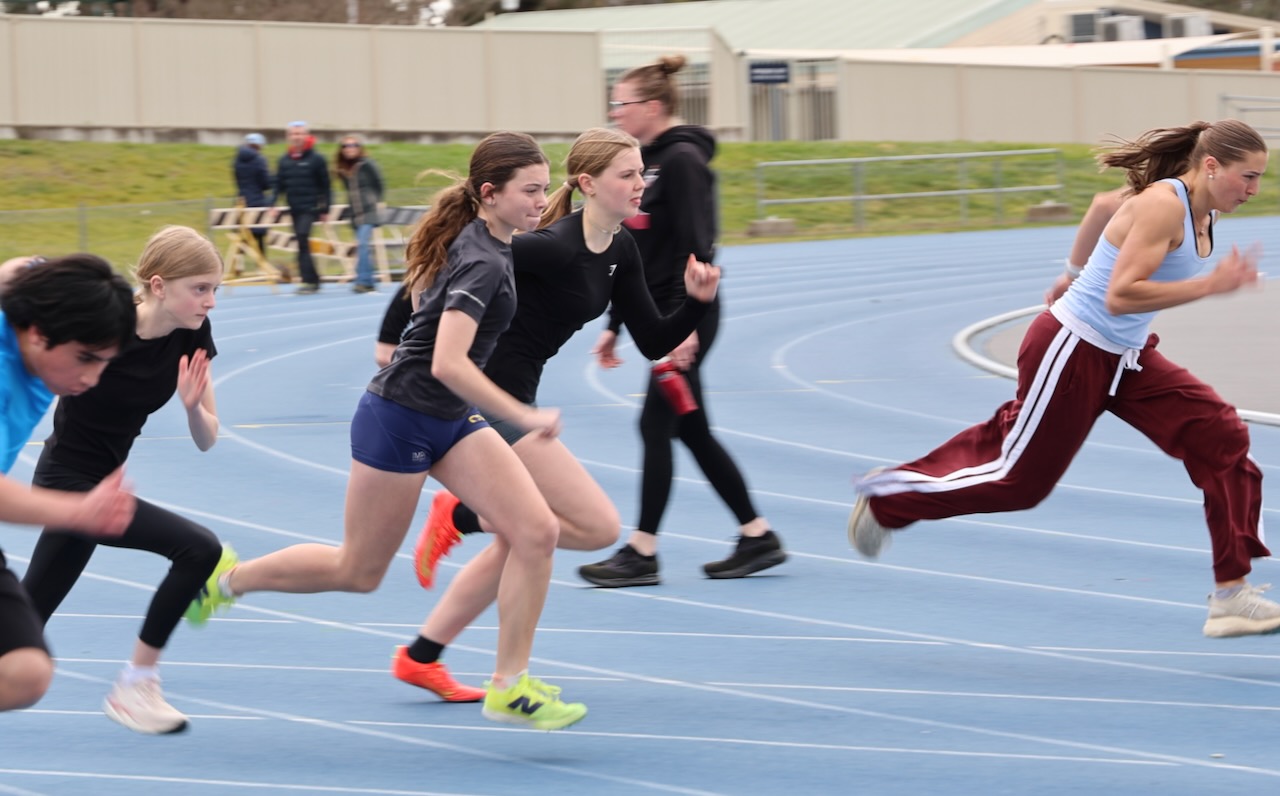
School athletics season has a way of making numbers feel very important.
A time appears on the results screen. There is a placing beside your name. Maybe it is a personal best. Maybe it isn’t. Someone else ran faster. Someone who you beat last year might suddenly be ahead of you.
For a young athlete, it is easy to look at that result and think it says something bigger about how good you are — or how good you might eventually become.
At FAST Running, we think there is a much better way to look at it.
We have begun analysing more than a decade of ACT school athletics results to understand how young athletes actually develop. The project will eventually examine the 100m, 200m, 400m and Long Jump, but we have started with one of the simplest measures in athletics:
The 100 metres.
And already, the results are fascinating.
Young Athletes Change — A Lot
One of the clearest findings is just how much performance can change during the teenage years.
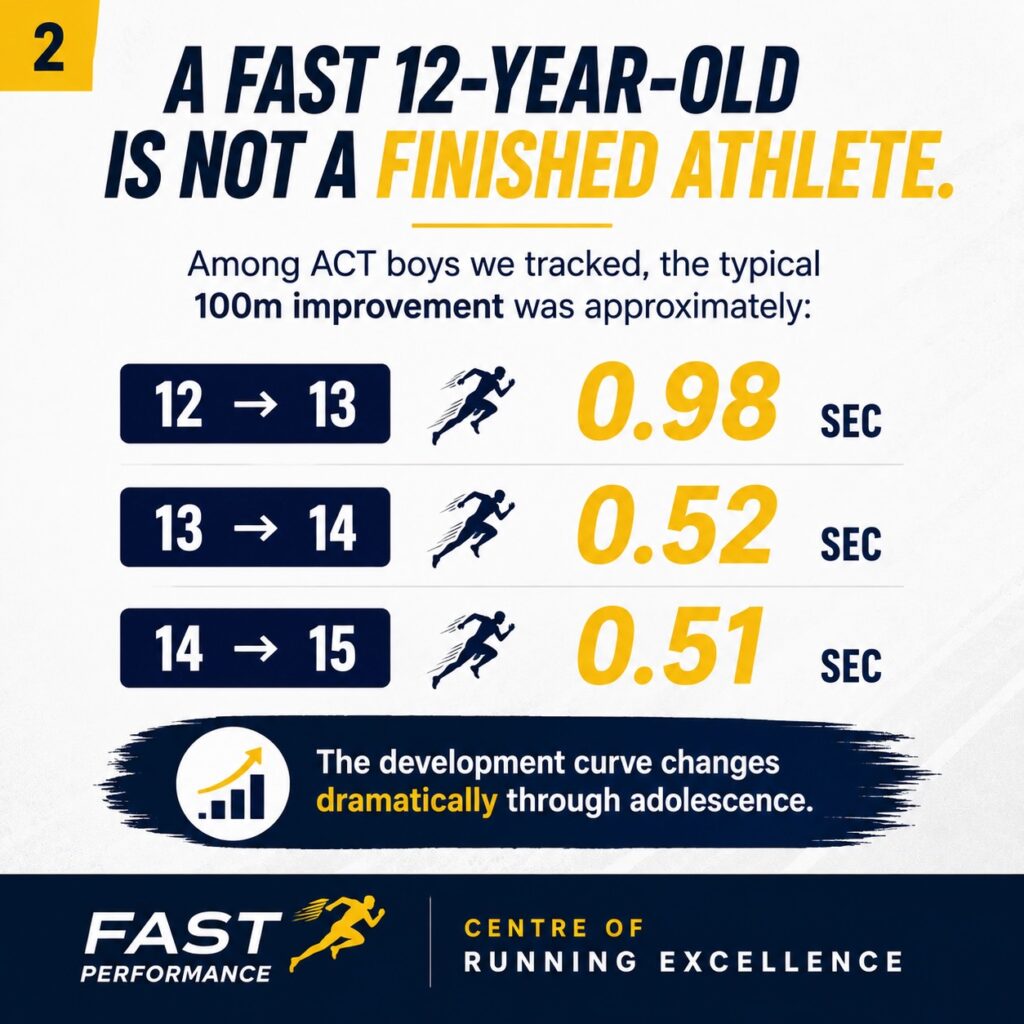
Among the ACT boys we have been able to track from one championship year to the next, the typical improvement from age 12 to 13 was close to a second over 100m.
The following years continued to produce substantial changes.
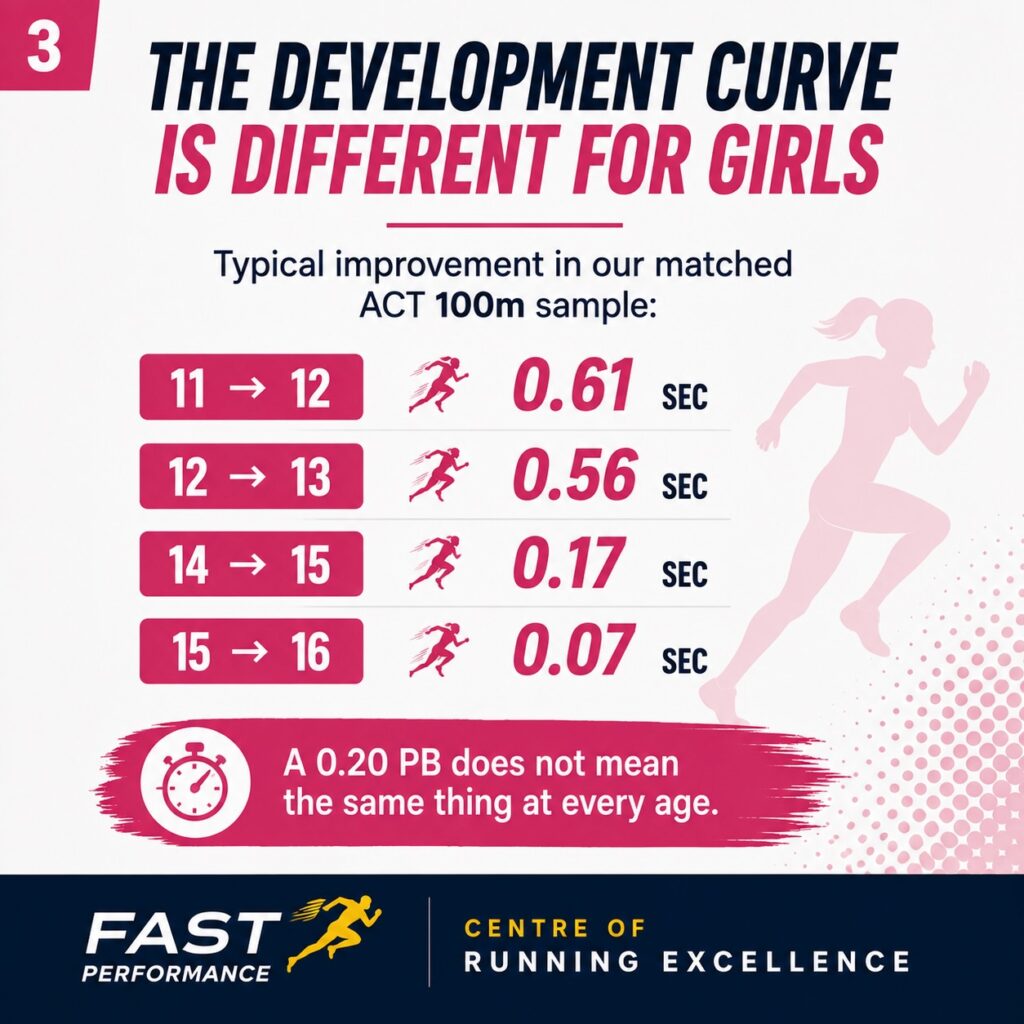
Girls showed a different pattern, with some of the largest typical improvements occurring between 11 and 13 before the rate of improvement became much smaller later in adolescence.
That doesn’t mean every athlete will follow those patterns.
That’s actually the point.
Development isn’t a straight line.
Some athletes develop earlier. Some later. Some improve steadily. Others seem to make very little progress before suddenly taking a big step forward.
That is why FAST coaches are interested in more than simply whether an athlete ran a PB.
Average at 12. One of the Fastest at 17.
One result from our historical data captures the idea particularly well.
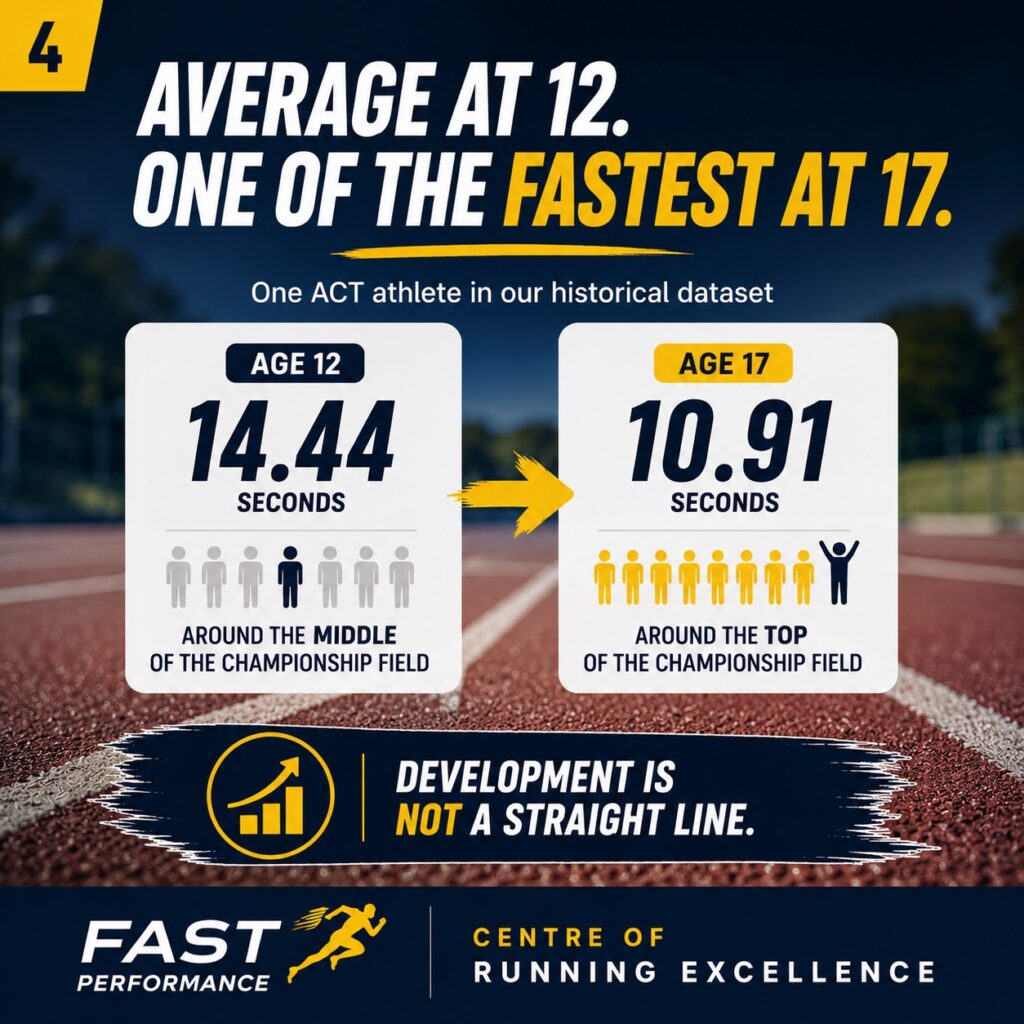
At age 12, one ACT boy ran 14.44 seconds for 100m. That placed him around the middle of the championship field.
Five years later, at 17, he ran:
10.91 seconds.
He had gone from somewhere around the middle of the field to being one of the fastest athletes of his age in the dataset.
There are other examples.
We found athletes who were already among the fastest when they were young and remained among the fastest as they got older.
But we also found athletes who were nowhere near the top at 11 or 12 and developed into outstanding teenage sprinters.
That gives young athletes an important message.
Where you are today matters. But it isn’t where your story has to finish.
Being Fast Young Still Matters
None of this means early performance is meaningless.
Far from it.
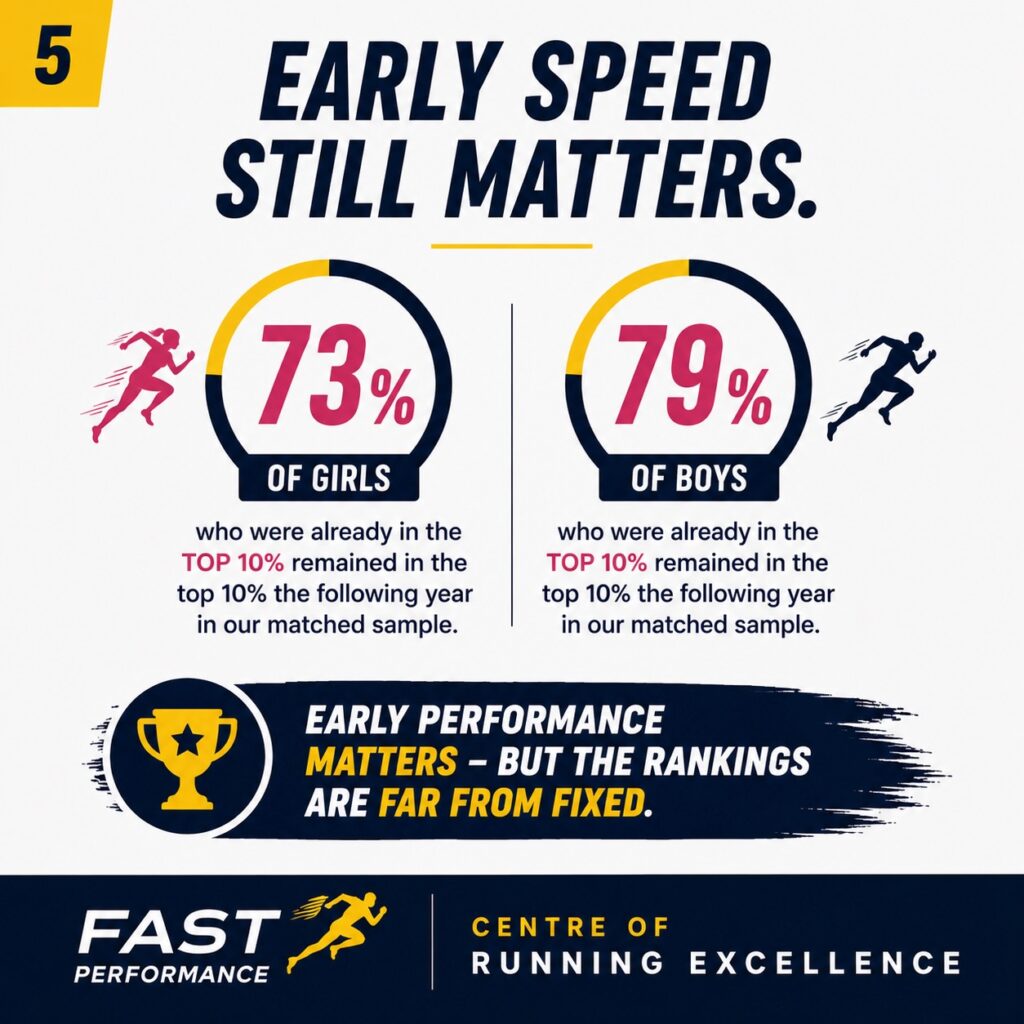
Among the athletes we could track from one championship year to the next, approximately 73% of girls and 79% of boys who were already in the top 10% remained in the top 10% the following year.
Being fast is a good sign.
But the rankings weren’t fixed.
Athletes moved up. Athletes moved down. And some athletes who started much further back eventually reached the very top.
So rather than asking only:
“How fast am I compared with everyone else?”
we think there is another question worth asking:
“How am I developing?”
Performance and Potential Aren’t the Same Thing
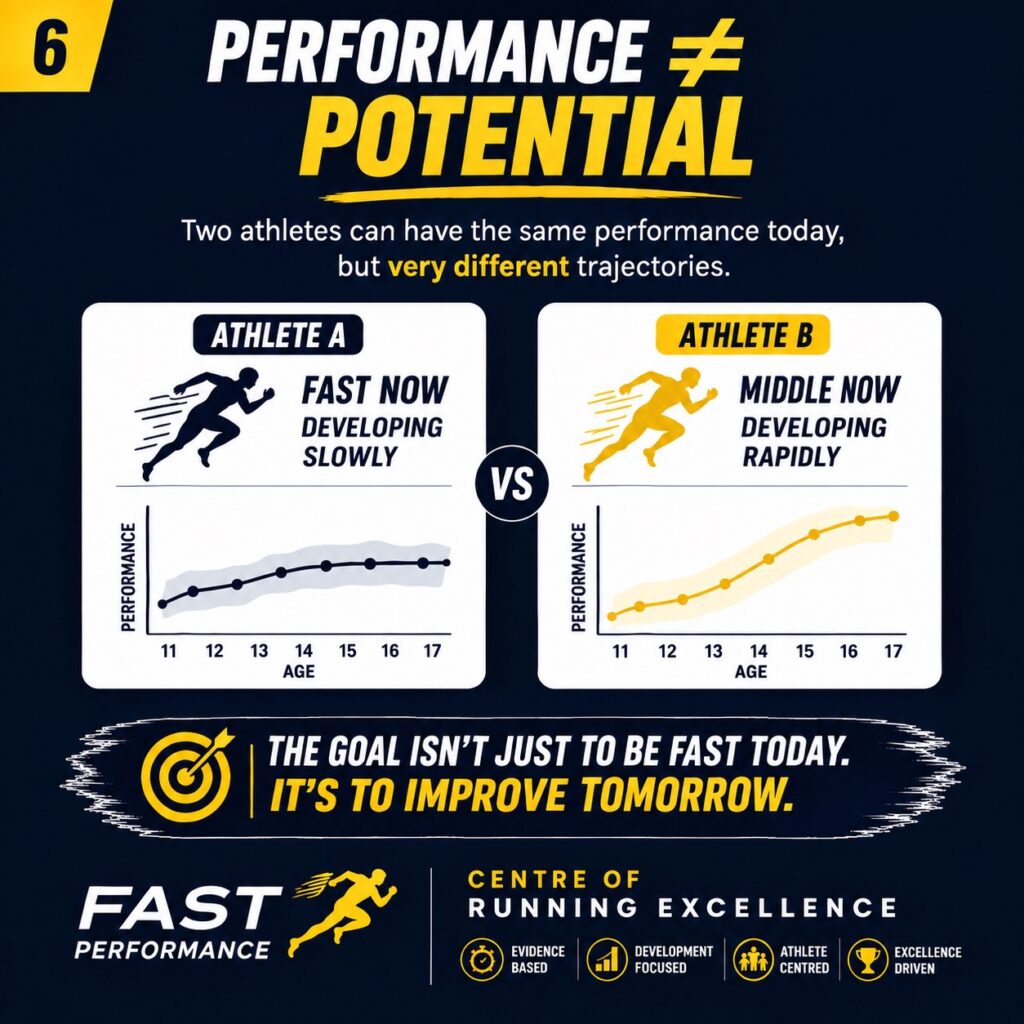
Imagine two athletes.
One is already one of the fastest athletes at school, but has changed very little over the past two years.
Another is currently somewhere in the middle of the field, but is improving rapidly.
Which athlete has more potential?
The stopwatch alone can’t answer that question.
And neither should a coach after watching one race.
At FAST, we want to understand both sides of an athlete’s performance:
Where are you now?
and
Where is your development heading?
That means looking at competition results, training performances, electronic timing, technical development, consistency and the athlete’s progression over time.
Data doesn’t replace coaching.
It gives coaching better information.
Why FAST Is Building This
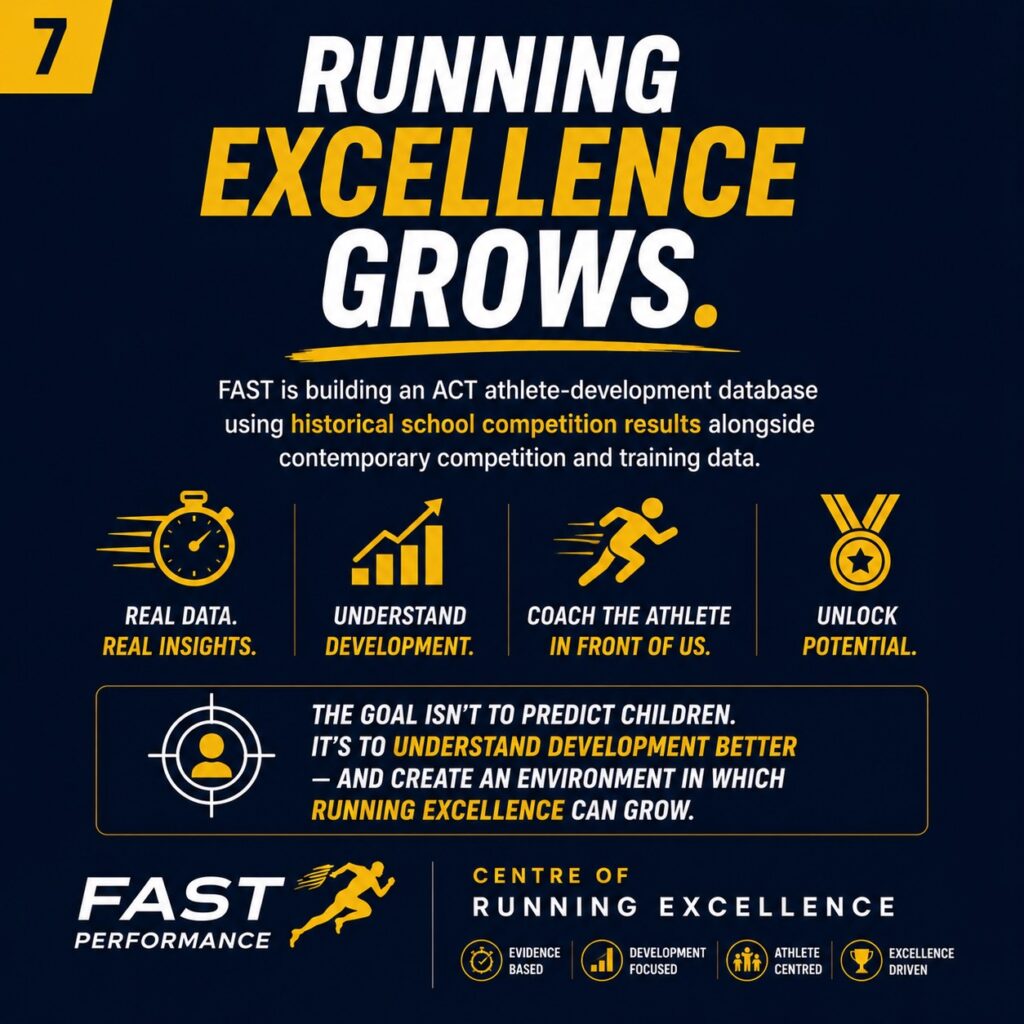
FAST Running has collected athlete performance information for years.
We electronically time athletes in training. We record flying sprints and acceleration performances. We follow competition results and personal bests. Increasingly, we can compare those performances with a much larger historical picture of athletics development in the ACT.
The aim isn’t to create another ranking table or a talent-prediction system.
And it certainly isn’t to predict the future of an 11-, 12- or 13-year-old athlete.
It is to understand development better.
If an athlete improves by 0.20 seconds, we want to understand what that means at their age and stage of development.
If an athlete isn’t improving as quickly as someone beside them, we want enough perspective not to panic and change everything.
If someone suddenly begins progressing rapidly, we want to recognise it.
And when training decisions need to be made, we want those decisions informed by evidence rather than guesswork.
Understanding What the Data Can Tell Us
There is an important limitation to this work. When we follow athletes from one championship year to another, we can only analyse those who continue to appear in the results. Athletes may disappear from the data for many reasons — they may change events, miss a championship, move, be injured or leave the sport altogether.
That means our historical data can show us the different development pathways that have actually occurred, but it cannot tell a 12-year-old their probability of becoming a particular type of 17-year-old.
For FAST, that distinction matters. We aren’t trying to use data to predict children. We are using it to better understand development, recognise that there are many pathways to high performance, and make better-informed coaching decisions along the way.
Running Excellence Grows
Athletics will always come back to something wonderfully simple.
Eventually, somebody starts the clock.
But what happens between those moments — between one race and the next, one season and the next, and one stage of development and the next — is much more complicated.
That is where coaching matters.
At FAST Performance, we are continuing to build the data, coaching systems and development environment that help us understand the athlete in front of us — not simply the number beside their name.
Because a result tells us what happened today.
Development tells us what we should work on tomorrow.
And that is how Running Excellence grows.

Comments are closed